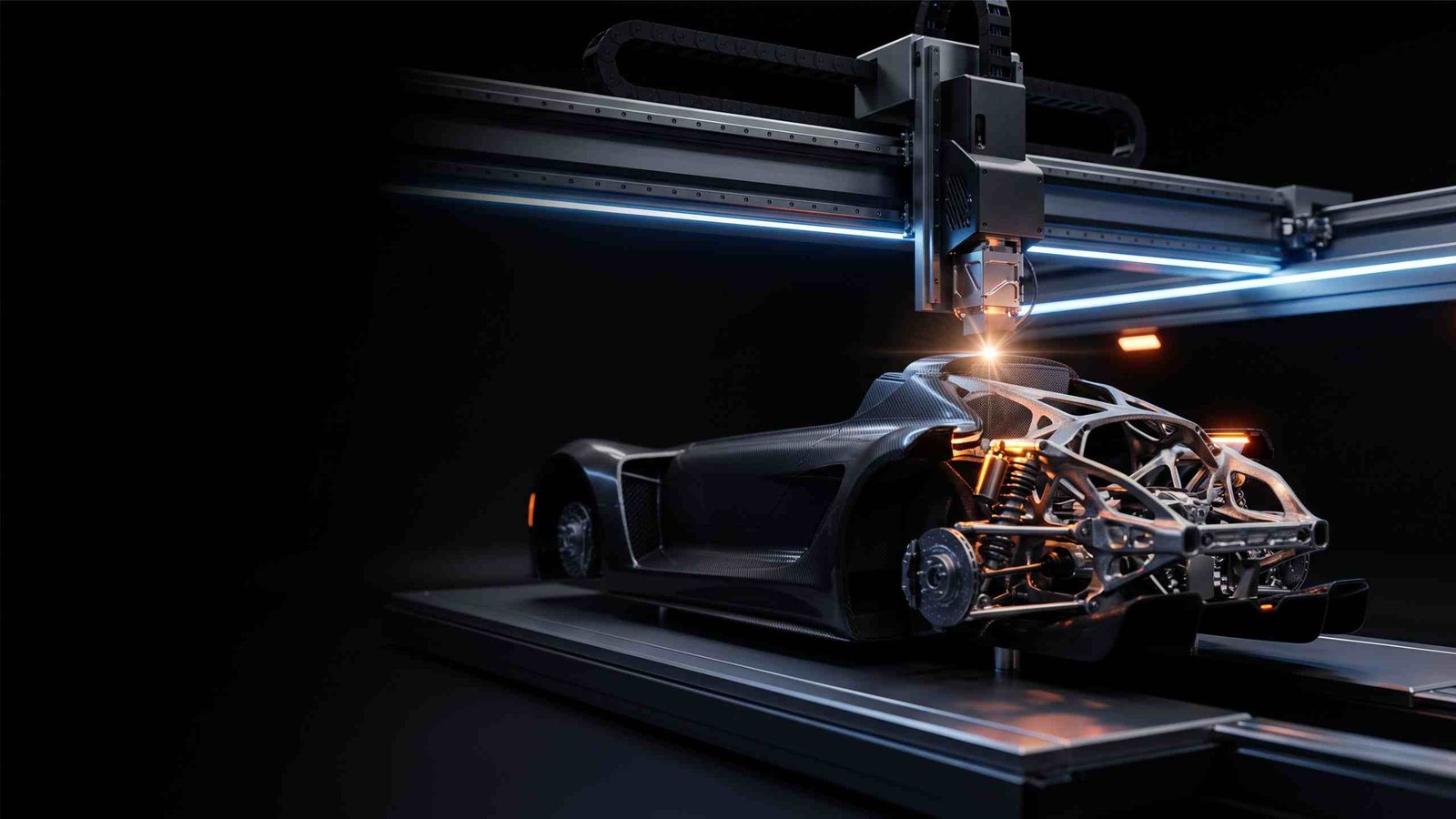
In February 2026 a team at Tsinghua University published a paper in Nature describing a printer that builds a complete, complex 3D object in 0.6 seconds. Not a layer. The whole thing. A few months later, in a small town in Germany's Black Forest, robots finished printing the walls of the world's first 3D-printed supermarket. And in Bur Dubai, a 2,000-square-metre mosque printed from concrete is preparing to welcome its first worshippers.
These are the 3D printing innovations that define 2026: the year additive manufacturing stopped being a story about prototypes and became a story about things people actually live in, eat, wear, launch and, increasingly, have implanted in their bodies. This guide walks through the twelve most important 3D printing advancements of the year, what the numbers behind them really mean, and which trends are worth watching into 2027.
The 60-second version
Speed: holographic "volumetric" printing now forms millimetre-scale objects in under a second, and desktop machines have crossed 800 mm/s with 12 nozzles.
Buildings: the first 3D-printed supermarket, a 100-home printed neighbourhood in Texas, a printed mosque in Dubai and printed bus stops in India all landed in the same 12 months.
Medicine: printed tissue can now grow blood vessels more than 800 micrometres deep, four times the old limit, which is the barrier that has kept printed organs in the lab.
Space and speed: fully printed rockets are on the pad in Florida and Sriharikota, and an AI-designed, 3D-printed hypercar holds production lap records.
Money: the industry earned $24.2 billion in 2025, up 10.9%, and for the first time nearly half of that came from printing services rather than selling printers.
The quiet shift: AI now designs the part, watches the melt pool and fixes the print mid-job. That, more than any single machine, is what makes 2026 different.
Why 2026 is a turning point for 3D printing
For twenty years the pitch for 3D printing was "imagine what you could make." The 2026 edition of the Wohlers Report, the industry's annual census, tells a different story. Global additive manufacturing revenue reached $24.2 billion in 2025, a 10.9% rise. That is healthy but well below the 20%-plus growth of the pre-pandemic years, and the report describes an industry "entering a new phase of maturation defined by performance and return on capital rather than prototype velocity."
The interesting number is inside the total. Printing services, where a company sends a file and receives finished parts, now make up 48% of the market and grew 15.5%. Printer sales grew just 3.6%. In other words, the innovations that matter in 2026 are not mostly about new machines. They are about what printers are being trusted to make: load-bearing walls, flight hardware, living tissue, and shoes you can buy at retail.
| Segment (2025) | Share of $24.2B | Growth |
|---|---|---|
| Printing services | 48% | +15.5% |
| Printers and servicing | 26% | +3.6% |
| Materials | 20% | n/a |
| Software | 6% | n/a |
Source: Wohlers Report 2026 (ASTM International / Wohlers Associates).
The 12 biggest 3D printing innovations of 2026
1. Printing a whole object in 0.6 seconds
Conventional 3D printers build objects one thin layer at a time, which is why even a small part can take hours. Volumetric printing instead projects patterns of light into a vat of resin so that the entire object solidifies at once, like a hologram becoming solid.
In February 2026 Tsinghua University's team published DISH (Digital Incoherent Synthesis of Holographic light fields) in Nature. A rotating periscope steers light through a micromirror chip that flips 17,000 times a second, sculpting a stationary pool of resin into a finished millimetre-scale object in 0.6 seconds, with sharp detail from top to bottom. The researchers name three uses: mould-free mass customisation, printing tissue directly inside the body during surgery, and parts for tiny robots. Work at UC Berkeley and Lawrence Livermore on the related "computed axial lithography" approach is pushing the same idea toward larger objects.
Why it matters: speed has always been the tax on 3D printing. Sub-second forming removes it for small parts, and small parts (dental aligners, hearing aids, microfluidic chips, drug-delivery devices) are exactly where printing already earns money.
2. The world's first 3D-printed supermarket
In Neubulach, a town in Germany's Black Forest, discount chain Netto Marken-Discount commissioned a store whose walls were extruded by robots rather than laid by hand. PERI 3D Construction printed more than 1,300 square metres of wall for a 1,700-square-metre store, with construction group Züblin (Strabag) and Heidelberg Materials supplying the build and the printable concrete. It was completed in 2026 and is the first supermarket anywhere built this way.
Printed houses have existed for a decade. A commercial building for a national chain, designed to be repeated, is a different signal: a retailer has decided that printing is cheaper or faster than the alternative at scale.
3. A 100-home printed neighbourhood, and homes for under $99,000
Outside Austin, Texas, ICON and homebuilder Lennar have essentially finished Wolf Ranch, a community of 100 3D-printed homes and the largest of its kind. Each was printed by ICON's Vulcan machine, a 14-metre-wide gantry that lays down wall systems for a 3,000-square-foot house with a skeleton crew.
The more radical 2026 news is smaller. ICON's Initiative 99 challenged architects worldwide to design a printable home that costs $99,000 or less to build. In 2026 the first four winning designs were completed at Community First! Village, a supportive housing community in Austin. ICON has also unveiled Phoenix, a multi-storey printing robot intended to cut the cost of printed buildings further. Printed housing is now being tested against the hardest metric there is: whether it can be genuinely affordable.
4. Dubai prints a mosque, and aims at 25% of all new buildings
Dubai has been the world's most ambitious public backer of construction printing since 2016, when the Dubai 3D Printing Strategy set a target for 25% of the city's new buildings to be 3D printed by 2030. The city already holds two Guinness World Records: the Office of the Future (2016), the first 3D-printed commercial building, whose structure was printed in 17 days; and the Dubai Municipality innovation centre in Al Warsan, a two-storey, 640-square-metre, 9.5-metre-tall building that used 50% less manpower and produced 60% less waste than conventional methods.
The 2026 milestone is the 3D-printed mosque in Bur Dubai. Designed by JT+Partners for the Islamic Affairs and Charitable Activities Department, it covers 2,000 square metres, holds 499 worshippers, and was budgeted at Dh18 million. The prayer hall sits on a sculpted base with an open, walkable space beneath and a ramp spiralling up to a rooftop viewing platform looking toward Dubai Creek. Three specialists operate the printer. IACAD scheduled the opening for 2026; check its channels for the exact date, because this will be the first house of worship of its size ever produced by a machine.
5. India builds with printers, from a post office to bus stops
India's construction printing story is led by Tvasta, a startup founded by IIT Madras alumni. It printed India's first 3D-printed house, a 500-square-foot home on the IIT Madras campus, in 21 days. In 2025 it delivered India's first 3D-printed villa with Godrej Properties in Pune, and in 2026 it deployed printed bus-stop structures, a sign that the technology is moving into everyday public infrastructure. Tvasta uses its own extrudable concrete mix of cement, sand, geopolymers and fibres and claims structural costs of roughly ₹1,000 to ₹2,500 per square foot with far less material waste.
Separately, L&T printed a fully functional post office in Bengaluru's Cambridge Layout in 2023, roughly 1,021 square feet completed in about 43 days. For a country that needs to add housing at enormous scale in extreme heat and monsoon conditions, printed concrete's speed and low labour intensity make it one of the innovations to watch most closely.
6. Printed tissue that grows its own blood vessels
The reason you cannot yet order a 3D-printed kidney is not printing resolution. It is oxygen. Cells deeper than roughly 200 micrometres from a blood supply die, so bioprinted constructs have been limited to thin sheets.
In a study published in Advanced Materials in February 2026, researchers at UMC Utrecht combined volumetric bioprinting with a phase-separation trick: by tuning light intensity inside a dextran-based hydrogel they created controlled porosity, and blood-vessel-lining cells then grew networks more than 800 micrometres into the tissue, over four times the old limit. Thick constructs containing liver, bone and pancreatic cells were printed in seconds rather than hours. It does not give us a transplantable organ, but it removes the wall that everything else was stuck behind.
Two more 2026 results point the same way. Scientists at TU Wien printed biodegradable micro-scaffolds loaded with cartilage cells and regenerated functional cartilage in rabbits over 12 weeks, the first in-vivo demonstration at that resolution. And at Washington State University, a "scan, model, print" pipeline produced electronic skin for prosthetic hands that senses temperature and touch at ten times the spatial resolution of commercial alternatives. Meanwhile 3DBio Therapeutics' AuriNovo trial, which implanted a living ear printed from a patient's own cartilage cells, continues to enrol microtia patients.
7. Rockets printed almost whole, in Florida and in India
Relativity Space has moved its fully 3D-printed, reusable Terran R rocket into flight production and has said the first launch will come in 2026 from Cape Canaveral's Launch Complex 16. Terran R is designed to lift around 20 tonnes to low Earth orbit and return for reuse. Its Aeon engine is assembled from just three laser-sintered metal components, where a conventional engine has thousands of parts.
In India, Chennai's Agnikul Cosmos made history in May 2024 with Agnibaan SOrTeD, the first rocket ever flown on a single-piece 3D-printed engine, the Agnilet. The company now prints a complete engine in about seven days, a 97% cut in manufacturing time, and is designing Agnibaan around a plug-and-play cluster of four to fourteen engines to carry up to 100 kg to a 700 km orbit. Its next launch is targeted before the end of 2026, subject to approvals.
Above the atmosphere, the story continues: ESA's Metal3D printer produced the first metal part ever printed in space aboard the ISS in 2024, and NASA and Redwire have tested printing with simulated lunar soil in orbit, the groundwork for eventually printing Moon-base structures from Moon dust.
8. Cars and aircraft designed by AI and printed in metal
Czinger's 21C hypercar is the clearest demonstration of what happens when you let software design the structure. Parent company Divergent's Adaptive Production System uses AI to generate parts optimised for load, prints them in metal, and has robots assemble them with no fixed tooling. The result holds production-car lap records, and Bugatti has hired Divergent to optimise chassis and suspension components for its Tourbillon.
In September 2026 Divergent announced a partnership with defence company AEVEX to apply the same system to unmanned aircraft, compressing part counts and build timelines. The same month, the University of Maine launched 3Dirigo X, a 30-foot printed boat capable of nearly 40 knots, after raising its print rate from 20 to 500 pounds of material per hour. Large-format printing is no longer slow.
9. Shoes with no factory, no moulds and no stitching
After a decade of concept sneakers, 3D-printed footwear reached real shelves. Zellerfeld, with facilities in Austin and Hamburg, runs thousands of printers that turn a digital design into a finished shoe with no moulds, stitching or assembly. Its GEN3 platform powers Nike's Air Max 1000 and the new Air Max 95000, including a "Multicolor" edition where colour is programmed into the print as precisely as the geometry.
In March 2026 adidas unveiled Project R.A.P. and the BB.01, its first fully 3D-printed performance basketball shoe, built for a bespoke fit. With ASICS and Peak also shipping printed models, footwear has become the first consumer category where printing competes on cost and speed rather than novelty.
10. Printed steak, and cookies made from plastic waste
Israeli company Steakholder Foods is launching Perfecta, a 3D-printed plant-based whole-cut steak, in the northeastern United States in the second half of 2026, with tenderloin, flank and chicken-fillet blends in development. Its printers deposit "muscle" and "fat" separately to reproduce marbling, the texture problem that has held back plant-based meat. Rival Redefine Meat's printed steaks are already on menus in London, Amsterdam and Berlin.
The stranger 2026 headline came from Southern Illinois University, where a NASA-backed team converted PET plastic into protein-rich printed cookies, nicknamed µBites, using engineered yeast and a hydrothermal process. It is a lab result, not a product, but it hints at how printing could close waste loops on long space missions.
11. Metal printing for $39,000, and lasers that finally handle copper
Industrial metal printers have long cost as much as a house. At CES 2026, Mastrex showed the MX100, a laser powder-bed metal printer starting at $39,000, while Ohsung's Gauss MT90 prints stainless steel, copper, titanium and aluminium from a paste with a HEPA-filtered, quick-start design aimed at small workshops. On the process side, green lasers now let machines melt copper, gold and silver reliably; those highly reflective metals bounced away the infrared lasers older printers used, which is why printed copper heat exchangers and motor windings were so rare.
12. AI in the loop: from text prompt to part, and from melt pool to fix
Two AI shifts bracket the 2026 3D printing story. At the consumer end, tools such as Meshy's Creative Lab and Tripo AI, which raised roughly 3 billion yuan in September 2026, turn a text prompt, a photo or a child's drawing into a print-ready file in under a minute, repairing geometry and even suggesting materials. Creality's SPARKX i7 ships with AI error detection and a portrait-to-3D tool built in. AtomForm's Palette 300 pushes desktop hardware to 12 nozzles, 800 mm/s and up to 36 colours in one print.
At the industrial end, agentic systems now watch the melt pool in metal printers, detect thermal drift and adjust parameters mid-job without a human. That makes unsupervised 24-hour printing realistic for the first time, which is the single biggest lever on cost per part. The CAD-skill barrier is falling for hobbyists at the same moment the babysitting cost is falling for factories.
3D printing advancements 2026 at a glance
| Innovation | Who | The number | Why it matters |
|---|---|---|---|
| Holographic volumetric printing | Tsinghua University | 0.6 s per object | Removes the speed penalty for small parts |
| First printed supermarket | Netto, PERI, Züblin | 1,700 m² | Retail chain chooses printing at scale |
| Wolf Ranch and Initiative 99 | ICON, Lennar | 100 homes; $99k target | Tests affordability, not just feasibility |
| 3D-printed mosque | IACAD Dubai, JT+Partners | 2,000 m², 499 worshippers | First printed house of worship at scale |
| Printed villa and bus stops | Tvasta, Godrej | ₹1,000–2,500 per sq ft | Printing enters Indian public infrastructure |
| Vascularised bioprinting | UMC Utrecht | >800 µm vessel depth | Breaks the oxygen limit on printed organs |
| Fully printed rockets | Relativity Space, Agnikul | Engine printed in 7 days | Slashes cost and lead time to orbit |
| AI-designed printed vehicles | Divergent, Czinger, UMaine | 500 lb/hour boat printing | Toolless factories for cars, drones, boats |
| Retail printed footwear | Zellerfeld, Nike, adidas | Thousands of printers | First consumer category to reach cost parity |
| Printed whole-cut steak | Steakholder, Redefine Meat | US launch H2 2026 | Solves texture, the biggest alt-meat complaint |
| Affordable metal printing | Mastrex, Ohsung | From $39,000 | Metal AM reaches small workshops |
| AI design and process control | Meshy, Tripo, AtomForm | 12 nozzles, 800 mm/s | Removes skill barrier and supervision cost |
What these innovations mean for the UAE and India
Both regions sit at the sharp end of two problems printing is good at: building fast in punishing climates, and manufacturing locally instead of importing. Dubai's 25% target gives construction printing a guaranteed customer for the rest of the decade, and the mosque will be the reference project every other Gulf city studies. Abu Dhabi and Saudi Arabia have already licensed printed villas and, in the Saudi case, one of the largest printed buildings in the world.
India's advantage is cost engineering. Tvasta's ₹1,000-per-square-foot floor and Agnikul's seven-day engine are the kind of numbers that only emerge when a technology is forced to compete with cheap labour and tight budgets. If printed concrete can pass Indian monsoon and seismic codes at that price, the addressable market is not a few showcase villas but tens of millions of homes.
Read next on BLUFF: Humanoid robots in 2026, What is physical AI?, Quantum computing breakthroughs of 2026, and Solid-state batteries explained.
3D printing trends to watch into 2027
Volumetric goes bigger. Expect the sub-second holographic method to scale from millimetres to centimetres, which puts dental, hearing-aid and micro-device production in reach.
The first flights of fully printed rockets. Terran R's debut and Agnikul's return to the pad will show whether printed engines survive the ultimate stress test.
Vascularised tissue in animal trials. Utrecht's 800-micrometre result will be pushed toward implantable patches for liver and pancreas.
Multi-storey printing. ICON's Phoenix and PERI's supermarket point to apartment blocks, not just villas.
Standards catch up. ASTM's new Critical and Emerging Technologies division is writing rules across 25 countries, which is what insurers, regulators and building codes have been waiting for.
Printing services keep outgrowing printer sales. The Wohlers numbers say the winners are the companies that own the parts business, not the machine business.
Frequently asked questions
What is the latest 3D printing technology in 2026?
The headline advance is holographic volumetric printing, demonstrated by Tsinghua University in February 2026, which forms an entire millimetre-scale object in 0.6 seconds instead of building it layer by layer. Other major 2026 developments include vascularised bioprinting, affordable laser metal printers from about $39,000, green-laser copper printing, and AI systems that design parts and control prints autonomously.
Can you really 3D print a house in 2026?
Yes. ICON has printed a 100-home community in Texas, Tvasta has printed homes and a villa in India, and Dubai has printed offices and a mosque. Printers typically extrude the wall system; roofs, windows, plumbing and finishes are installed conventionally. Print times for a small house range from days to about three weeks.
Can organs be 3D printed yet?
Not whole organs for transplant. The 2026 breakthrough from UMC Utrecht grew blood-vessel networks more than 800 micrometres into printed tissue, four times the previous limit, and a bioprinted living ear has been implanted in a clinical trial. Most researchers expect transplant-grade printed organs to be a 2030s development.
How big is the 3D printing industry?
According to the Wohlers Report 2026, global additive manufacturing revenue was $24.2 billion in 2025, up 10.9% on the year. Printing services made up 48% of that, followed by printers and servicing (26%), materials (20%) and software (6%).
Is 3D printing used in space?
Yes. The first metal part printed in space was produced on the International Space Station in 2024 by ESA's Metal3D printer, NASA and Redwire have tested printing with simulated lunar soil in orbit, and Relativity Space and Agnikul Cosmos are building rockets whose engines are almost entirely 3D printed.
What is the future of 3D printing?
The industry is shifting from prototypes to production. Expect volumetric printing to scale up, printed buildings to move from villas to multi-storey blocks, printed tissue to enter animal and early human trials, and AI to handle both design and unsupervised print monitoring, driving down cost per part.
The bottom line
The 3D printing innovations of 2026 share one theme: the printer has become the least interesting part of the story. A printed supermarket matters because a retailer trusted it. A 0.6-second print matters because it can be repeated ten thousand times an hour. An 800-micrometre blood vessel matters because it was the wall between a lab curiosity and a treatment. Twenty years after the first desktop machines, additive manufacturing is finally being judged on what it makes, and in 2026 what it makes includes homes, rockets, shoes, steak and living tissue.
Sources consulted: Wohlers Report 2026 (ASTM International); Tsinghua University and Nature, February 2026; Strabag/Züblin, PERI 3D Construction and Heidelberg Materials on the Neubulach supermarket; ICON project pages; Khaleej Times, Time Out Dubai and IACAD on the Bur Dubai mosque; Dubai Future Foundation and Dubai Media Office; Tvasta Construction; UMC Utrecht and Advanced Materials; 3DPrint.com news briefs, September 2026; Relativity Space; Press Information Bureau of India and Agnikul Cosmos; Hypebeast, WWD and Business of Fashion on printed footwear; FoodIngredientsFirst on Steakholder Foods; 3Dnatives on CES 2026; ESA and NASA on in-space printing.