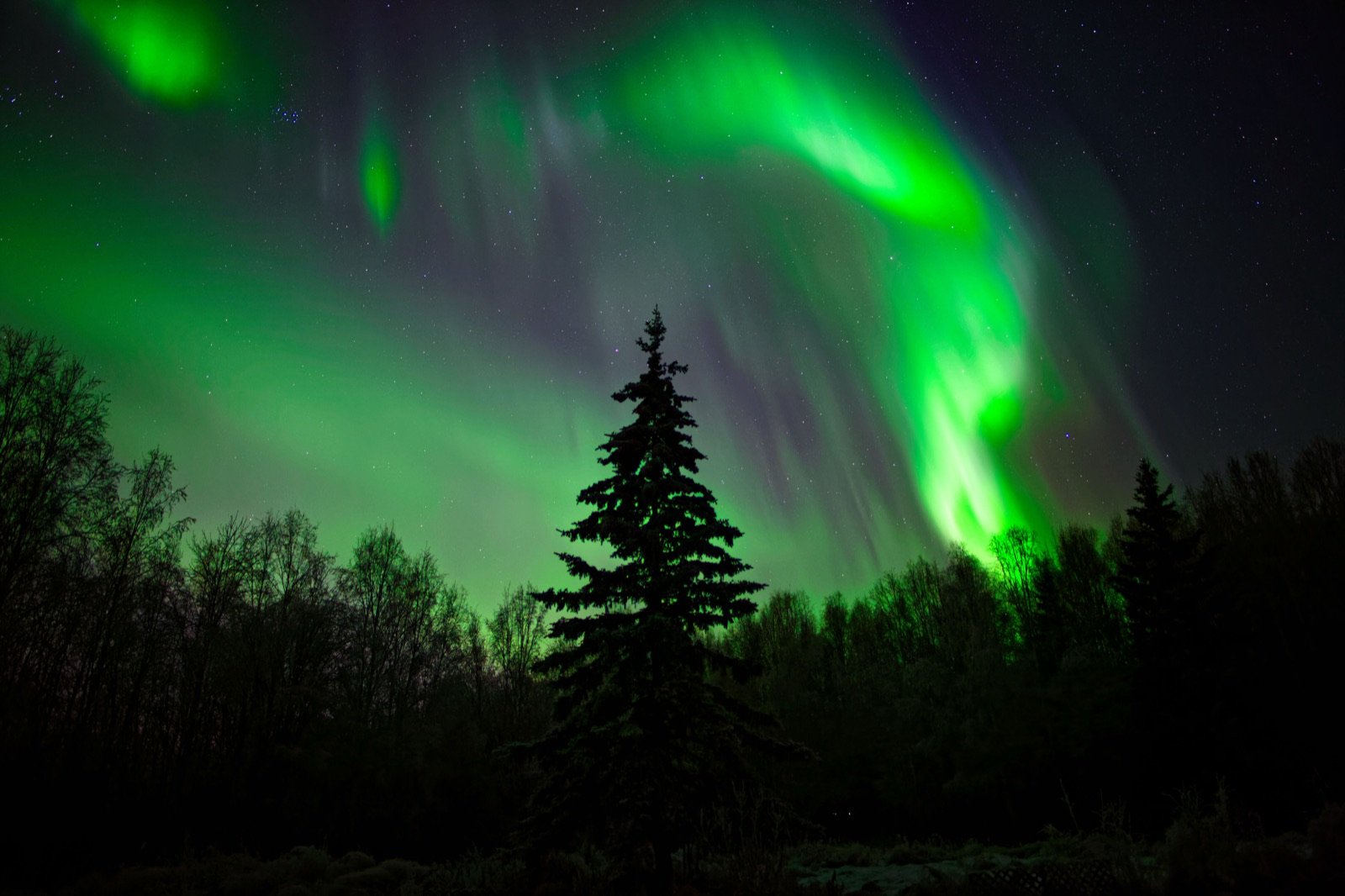
On the night of 19 January 2026, people in Arizona, Texas and southern California stepped outside and saw something that belongs in Norway. Across the Atlantic, a resident of Zurich drove up a mountain after an app alert and watched a red-green glow spread over the Alps. The geomagnetic index hit Kp 9, the top of the scale, in one of the strongest solar storms in more than 20 years.
That storm happened fifteen months after the sun's official peak. It's the clearest possible signal of what this post is about: the 2026–27 aurora season is not the afterglow of the solar maximum. It sits inside the strongest part of the cycle, and we won't get another window like it until the mid-2030s.
So let's answer the question properly. When, exactly, is the best time to see the northern lights? And where should you stand?
The short answer
The best time to see the northern lights is from late September to late March, between roughly 9 pm and 2 am local time, on a clear night within a week of the new moon, at a latitude between about 65° and 72° North.
For the 2026–27 season specifically, the sweet spots are:
| Window | Why it's good |
|---|---|
| 20 Sept – 20 Oct 2026 | Autumn equinox effect: geomagnetic storms are statistically almost twice as common around the equinoxes. Milder weather, lakes not yet frozen (mirror reflections). |
| Late Nov 2026 – Feb 2027 | Longest, darkest nights. Up to 18+ hours of darkness above the Arctic Circle. Coldest but clearest skies inland (Abisko, Fairbanks, Yellowknife). |
| 1 – 25 March 2027 | Spring equinox effect again, plus longer, safer daylight for daytime activities. Historically the single best month in Iceland and Lapland. |
Bookmark the new-moon dates for darkest skies: 11 Sept, 10 Oct, 9 Nov, 9 Dec 2026 and 7 Jan, 6 Feb, 8 Mar 2027 (check your local calendar; dates shift by a day depending on time zone).
Now the interesting part: why this particular winter.
Why 2026–27 is special: the science of a "declining" sun that refuses to calm down
The sun runs on an eleven-year rhythm called the solar cycle. We're in Solar Cycle 25, and according to NOAA's Space Weather Prediction Center, it peaked in October 2024 with a smoothed sunspot number of about 161, well above what forecasters predicted back in 2019.
The obvious assumption is that the show is now winding down. The data says otherwise:
The 2025 annual sunspot mean was about 123, still high (2019, at the last minimum, was under 4).
Sunspot numbers in 2026 remain far above the cycle's quiet baseline.
The next solar minimum isn't expected until around 2031, and the next maximum not until the mid-2030s.
More importantly, the declining phase of a solar cycle has a reputation among space-weather scientists for producing the most violent storms of all. Three reasons:
Coronal holes. As the cycle declines, large, long-lived holes open in the sun's outer atmosphere and fire fast streams of solar wind at Earth. These recur every 27 days as the sun rotates, so the aurora comes back on a schedule.
Storm clustering after the peak. The famous Halloween Storms of October 2003 hit two years after Solar Cycle 23 peaked in 2001. History rhymes: the January 2026 storm arrived fifteen months after this cycle's peak.
Magnetic complexity. As the sun's magnetic field reorganises toward minimum, it becomes more tangled and prone to sudden, sharp eruptions.
The January 2026 event showed all of this. A coronal mass ejection left the sun and reached Earth in roughly 25 hours instead of the usual three to four days, travelling at around 1,660 km/s, one of the fastest since 1995.
The honest framing: 2026–27 is not your "last chance". It is, however, the last winter with the odds this heavily in your favour for close to a decade. If you've been putting the trip off, stop putting it off.
Best months to see the northern lights (ranked)
Aurora activity itself doesn't care what month it is. What changes is darkness, weather and the equinox effect. Rank them together and you get this:
| Rank | Month | Darkness | Weather | Verdict |
|---|---|---|---|---|
| 1 | March | Long nights, returning daylight | Driest month in much of Lapland and Iceland | Best overall balance |
| 2 | Late Sept / Oct | Full darkness returns | Mild, autumn colours, ice-free lakes | Best for comfort and reflections |
| 3 | Feb | Very long nights | Cold but stabilising | Great in Alaska and Yukon |
| 4 | Nov | Very long nights | Wettest month on coasts (Tromsø, Reykjavik) | Go inland |
| 5 | Dec / Jan | Maximum darkness (polar night) | Cloudiest and coldest | Big payoff, big gamble |
The equinox boost is real and has a name: the Russell-McPherron effect. Around the equinoxes, Earth's magnetic field lines up more favourably with the solar wind, so the same solar activity produces stronger geomagnetic storms. Statistically, geomagnetic disturbances are roughly twice as frequent in March and September/October as in June and December.
Best time of night
Aurora activity peaks around local magnetic midnight, which in most Arctic destinations falls between 10 pm and 1 am. The realistic viewing window is 9 pm to 2 am.
Two tips travellers miss:
Don't go to bed at midnight. Substorms, the sudden bright explosions of colour, often come in waves an hour or two apart. The best display of the night is frequently the second or third one.
Check the 27-day recurrence. If a strong aurora was reported on a date, mark 27 days later. If it came from a coronal hole, there's a decent chance of a repeat as the sun's rotation brings it back into position.
Best places to see the northern lights in 2026–27
The classic Arctic belt (highest odds)
| Destination | Latitude | Why | Best months |
|---|---|---|---|
| Tromsø, Norway | 69.6°N | Direct flights, tours in every direction, Gulf Stream keeps it milder | Oct – Mar |
| Abisko, Sweden | 68.3°N | The "blue hole" microclimate is famous for clear skies when everywhere else is clouded | Dec – Mar |
| Finnish Lapland (Rovaniemi, Inari, Levi) | 66–69°N | Glass igloos, forest silence, very good odds on a 4-night stay | Sept – Mar |
| Iceland (outside Reykjavik) | 64–66°N | Cheap flights, dramatic foregrounds, but unstable coastal weather | Sept – Oct, Feb – Mar |
| Fairbanks, Alaska | 64.8°N | Inland, dry, cold, and statistically excellent: locals quote 80–90% odds over a 3-night stay in winter | Feb – Mar |
| Yellowknife, Canada | 62.5°N | Flat, dry, sits right under the auroral oval | Jan – Mar, Aug – Sept |
The "surprise" belt (where the big storms reach)
If January 2026 taught us anything, it's that a strong storm rewrites the map. During Kp 7+ events, keep an eye on:
Scotland and northern England, where the January storm was naked-eye visible.
The Great Lakes states, Minnesota and Michigan.
Northern Germany, the Netherlands and Denmark.
Anywhere in Central Europe with a dark northern horizon.
You won't plan a trip around these. But if you live there, sign up for alerts (below) and be ready to drive 30 minutes away from city lights.
Northern lights from India?
Yes, genuinely, though only during extreme storms. The Indian Astronomical Observatory at Hanle, Ladakh (a certified Dark Sky Reserve at 4,500 m) photographed a deep-red aurora during the May 2024 superstorm and again in October 2024. These are "stable auroral red arcs", visible on camera more than to the eye, but they're real. For a Kp 8–9 event in 2026–27, Hanle and Leh are your best bets on the subcontinent. For a guaranteed show, an eight-night package to Finnish Lapland or Tromsø from Delhi or Mumbai is the practical route.
How to actually see them: the five things that matter more than luck
Get dark. Light pollution is the number one aurora killer. Drive at least 20–30 minutes from any town.
Get clear. A Kp 9 storm behind a cloud bank is worth zero. Choose destinations with dry inland climates (Abisko, Fairbanks, Inari) over dramatic coasts if aurora is the main goal.
Stay at least 3 nights. Ideally 5. Single-night trips are a coin flip. Over four or five nights in the auroral belt in winter, most operators report odds well above 80%.
Watch the right numbers. Download the NOAA 30-minute aurora forecast, SpaceWeatherLive, or an alert app like My Aurora Forecast or Hello Aurora. Look for Kp 3+ in the Arctic belt, Kp 5+ in Scotland or the northern US, Kp 7+ for Central Europe or the southern US. Also watch the Bz value: when it swings strongly negative (south), the aurora switches on.
Be patient and look north. Early aurora often looks like a grey, faint cloud. Take a 5-second phone photo. If it's green in the photo, stay out.
Kp cheat sheet
| Kp | NOAA scale | Who sees it |
|---|---|---|
| 2–4 | Quiet to active | Arctic belt only |
| 5 | G1 minor storm | Scotland, Scandinavia, northern US states |
| 6 | G2 moderate | Northern England, Germany, Great Lakes |
| 7 | G3 strong | Central Europe, mid-US |
| 8–9 | G4–G5 severe/extreme | Texas, Arizona, Alps, occasionally Ladakh |
How to photograph the northern lights with your phone
You no longer need a DSLR. Any recent iPhone or Android with Night Mode will out-perform your eyes.
Turn on Night Mode and set exposure to 3–10 seconds. iPhone: tap the Night Mode icon and slide the exposure to max. Android: use Pro/Night mode, ISO 1600–3200, shutter 5–10 s.
Use a tripod or lean the phone on anything solid. Even a car roof. Any shake ruins a long exposure.
Turn off flash and HDR. Focus manually on infinity or a distant light.
Shoot wide. Use the 0.5× ultrawide lens to capture the arc.
Get a foreground. A cabin, a person, a tree line. Pure sky photos are forgettable; a silhouette makes it a story.
Keep the phone warm. Batteries die fast at −20°C. Keep it in an inner pocket between shots.
Your 2026–27 aurora planning calendar
| Date | Event |
|---|---|
| 11 Sept 2026 | New moon. Season opens in Lapland and Iceland. |
| 22 Sept 2026 | Autumn equinox. Statistical storm boost begins. |
| 10 Oct 2026 | New moon. Prime autumn week. |
| 9 Nov 2026 | New moon. Polar night begins in Tromsø ~27 Nov. |
| 9 Dec 2026 | New moon. Darkest skies of the year. |
| 7 Jan 2027 | New moon. Watch the 27-day recurrence from the strong late-2026 storms. |
| 6 Feb 2027 | New moon. Alaska and Yukon peak. |
| 8 Mar 2027 | New moon. Best week of the entire season, right before the spring equinox on 20 March. |
Frequently asked questions
What causes the northern lights?
The sun constantly streams charged particles toward Earth (the solar wind). When they hit our magnetic field, they're funnelled toward the poles and collide with oxygen and nitrogen 100–300 km up. Oxygen glows green (and red at high altitude); nitrogen glows blue and violet. A solar storm is simply a bigger, faster burst of particles.
When can I see the northern lights in 2026?
From late September 2026 through late March 2027, on clear, dark nights between 9 pm and 2 am. The Arctic belt (Norway, Sweden, Finland, Iceland, Alaska, northern Canada) gives the best odds. The equinox weeks in late September and March are statistically strongest.
Is 2026 still a good year for the northern lights?
Yes. Solar Cycle 25 peaked in October 2024, but the declining phase of a cycle historically produces some of the strongest storms, and the January 2026 Kp 9 event proved it. Activity stays elevated through 2027 before declining toward a minimum around 2031.
Can I see the northern lights tonight?
Check the NOAA 30-minute forecast or SpaceWeatherLive. You need three things at once: darkness, clear skies, and a Kp value high enough for your latitude (see the cheat sheet above).
What is the best time of year to see the aurora borealis?
March is the best single month for the balance of darkness, dry weather and equinox activity. Late September to early October is the runner-up and far more comfortable.
Iceland or Norway for the northern lights?
Norway (Tromsø) for reliability and infrastructure; Iceland for scenery, cheaper flights and a road-trip feel. If aurora is the only goal, pick inland Sweden or Finland over both: fewer clouds.
Can you see the northern lights from India?
Only during extreme (Kp 8–9) storms, and mainly as a red glow on camera from high, dark sites like Hanle in Ladakh. For a real display, fly to Lapland.
How many nights do I need?
Plan a minimum of three, ideally five. Aurora is a probability game, and each extra clear night compounds your odds.
The bottom line
The sun peaked in October 2024. It hasn't calmed down, and history says the wildest nights often come on the way down. Between the equinox weeks of September 2026 and March 2027, on a clear night near a new moon, in the dark somewhere above 65°N, your odds of seeing the aurora are as good as they will be for almost ten years.
Go this winter. And when the sky finally goes green, put the phone down for at least one minute and just look up. That part, no camera can capture.
If you've seen the aurora this cycle, from Tromsø or from Texas, tell me where and when in the comments. I'm building a reader map of 2026–27 sightings.
Read next on BLUFF:
Valley of Flowers: a walk through India's high-altitude wonder
Quantum Computing: The Breakthrough Innovation Set to Redefine 2026
What Is Agentic AI? Inside the Autonomous AI Agents Changing How We Work in 2026
Sources: NOAA Space Weather Prediction Center; SILSO sunspot data (Royal Observatory of Belgium); Polar Journal and Forbes reporting on the 19 January 2026 storm; Space.com on Solar Cycle 25's declining phase; Indian Institute of Astrophysics (Hanle aurora observations, 2024).