Quantum computing has spent years living on a promise: that one day, a machine exploiting superposition and entanglement would solve problems classical computers never could. In 2026, that promise has started converting into hardware you can actually point to — chips shipped to national labs, error rates that fall instead of climb, and a demonstration that briefly reopened the debate over what "quantum supremacy" even means. Here's what's genuinely new this year, separated from the recycled hype.
Why does room-temperature quantum computing matter?
The biggest practical obstacle to quantum computers has never been the physics — it's the plumbing. Most qubits today only hold their delicate quantum states inside dilution refrigerators cooled to a hair above absolute zero, machines that are expensive, bulky, and hard to scale. That's what makes a 2026 Stanford result so notable: researchers built a device that uses twisted light to entangle photons and electrons at room temperature, sidestepping the extreme cooling requirement entirely. It won't replace superconducting processors overnight, but it points toward smaller, cheaper quantum hardware that could eventually sit in a server rack rather than a physics lab basement.
Neutral-atom quantum computing has made a parallel leap. By trapping individual atoms with laser tweezers and using them as qubits, companies in this space can now rearrange hundreds of atoms mid-computation — a flexibility superconducting chips, with their fixed wiring, simply don't have. It's one reason neutral-atom systems are being described as 2026's biggest architectural leap rather than an incremental update.
What is exponential error correction and why is it the real milestone?
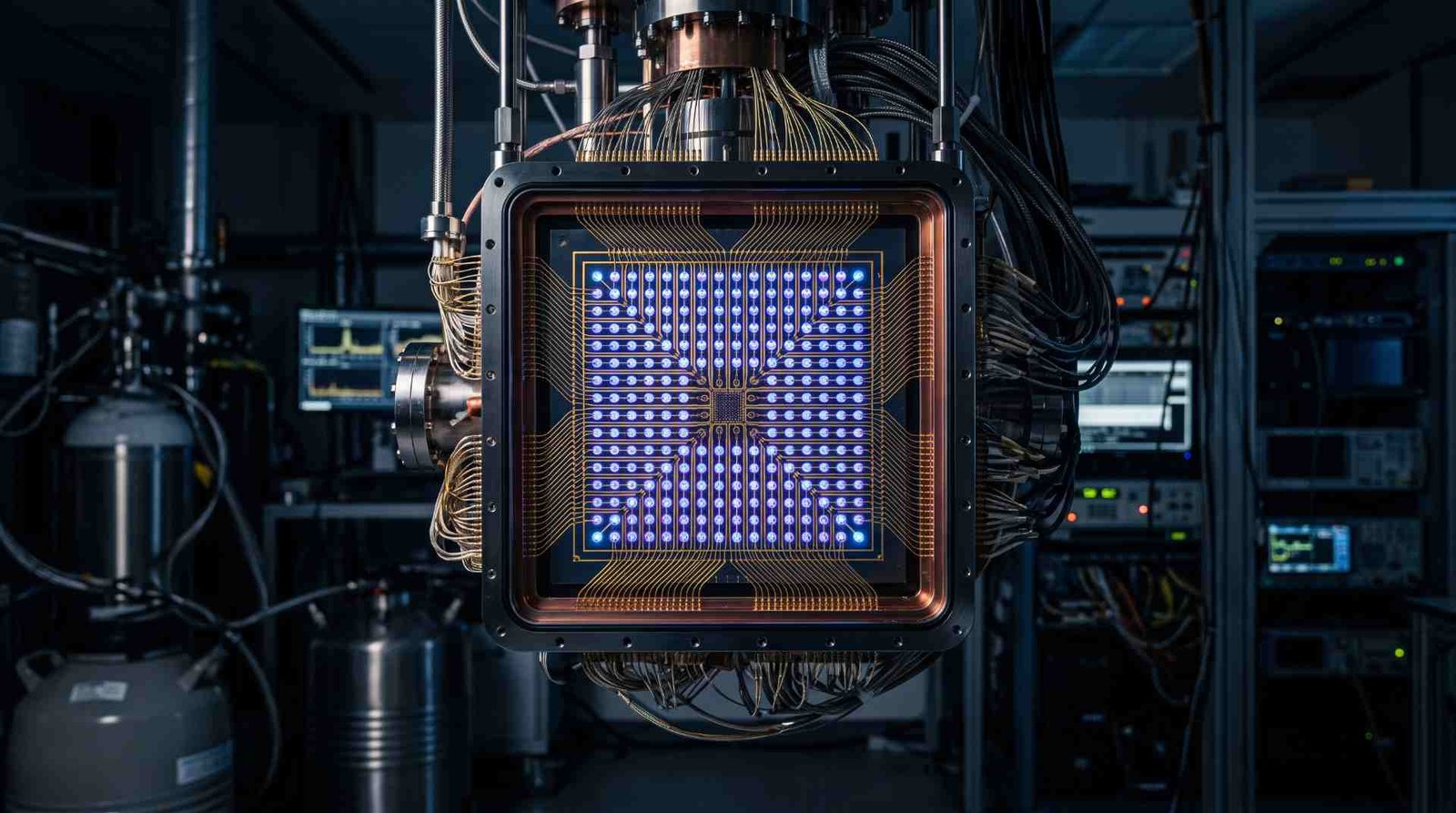
For decades, the practical case against quantum computing was simple: qubits are noisy, and adding more of them made errors worse, not better. That assumption broke down with Google's Willow processor, a 105-physical-qubit superconducting chip that demonstrated logical error rates falling by a factor of roughly 2.14x every time the surface-code lattice size increased. Through 2026, multiple labs — not just Google — have reproduced this "below threshold" behavior, confirming it wasn't a one-off. This is the theoretical scaling curve physicists have chased since error correction was first proposed nearly thirty years ago, and its repeated confirmation this year is arguably a bigger deal than any single flashy demo, because it's the difference between quantum computers that stay experimental and ones that can eventually run real workloads reliably.
Not everything has gone one direction, either. A 2026 result from a Simons Foundation-backed team used quantum dynamics simulations to challenge an earlier "quantum supremacy" claim, showing a classical algorithm could reproduce results once thought to require a quantum computer. Rather than a setback, researchers in the field have treated it as healthy scientific pressure-testing — exactly the kind of scrutiny a young field needs before anyone builds critical infrastructure on top of it.
Is quantum computing actually available to use yet?
This is the question that separates 2026 from prior "breakthrough" years: hardware is shipping. QuEra recently delivered its second commercial quantum computer to Japan's National Institute of Advanced Industrial Science and Technology, giving researchers there hands-on access rather than remote cloud queue time. The U.S. Department of Energy's national quantum research centers also reported milestone progress using cryoelectronics to control ion traps — a step aimed squarely at the scaling problem rather than another one-off record.
The commercial shape of quantum computing in 2026 increasingly looks like cloud computing's early years: enterprises don't want to own a dilution refrigerator any more than they wanted to own a server farm in 2010. Hybrid quantum-classical workflows, where a classical computer handles most of a job and hands a narrow, hard subroutine to a quantum processor, have become the default way anyone outside a physics department actually touches this technology. If you want the deeper mechanics of how logical qubits and error correction work, our earlier look at the quantum computing breakthrough reshaping 2026 goes further into the fundamentals.
What comes next?
None of this means fault-tolerant, universal quantum computers are sitting on shelves — they're not, and won't be for years. But 2026 is the year the field's central open question, "does error correction actually scale the way theory predicts," got a real, repeated, hardware-backed answer: yes. Combined with room-temperature entanglement research and actual machines being shipped to labs instead of just announced in press releases, quantum computing has quietly shifted from a subject physicists argue about to one engineers are starting to build around — a shift that echoes how agentic AI moved from lab curiosity to deployed tool in barely two years. The gap between "interesting physics" and "useful computer" is closing faster than most people outside the field have noticed.