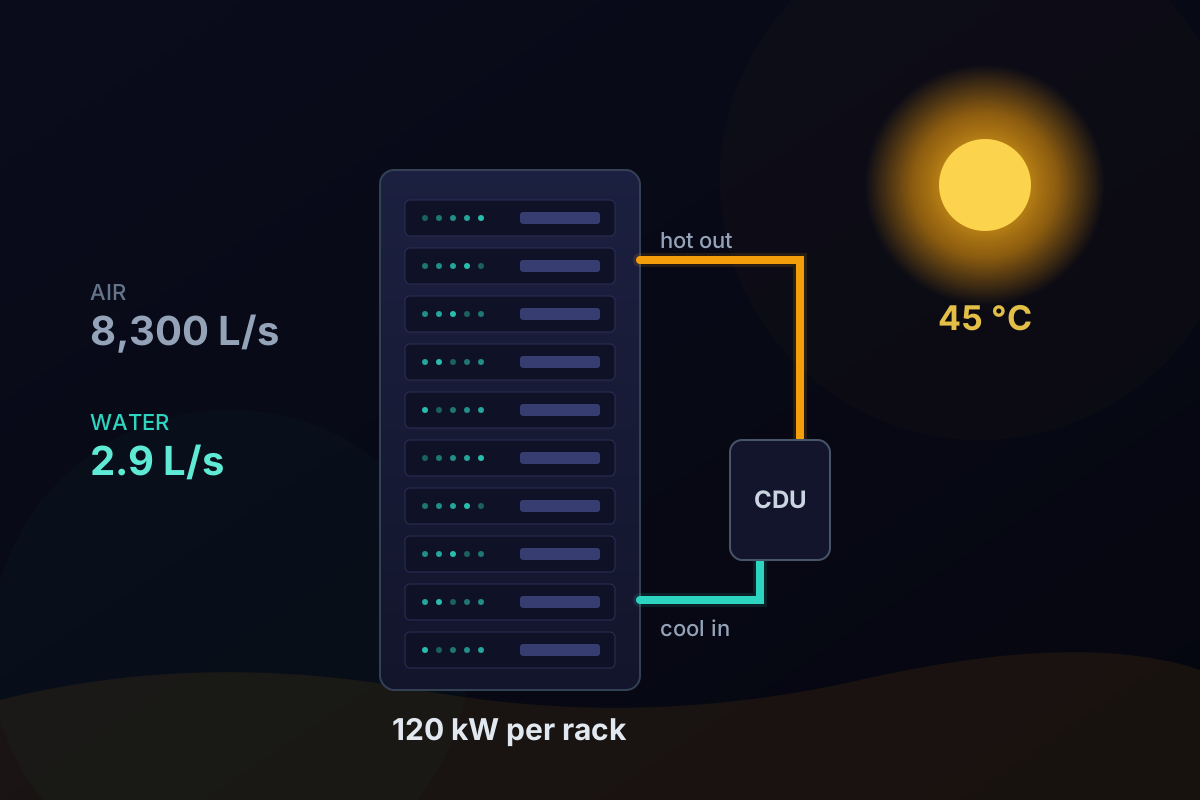
A rack of AI servers now draws as much power as a small apartment block. Air simply cannot carry that much heat away, so the industry is moving to liquid cooling. In the Gulf, where outdoor air sits at 45 °C in summer and fresh water comes from desalination plants, that shift changes the whole MEP (mechanical, electrical and plumbing) design, not just the white space.
Why this is the HVAC story of the year
For most of the last twenty years, a typical server rack drew around 5 to 10 kW. Raised floors, computer room air handlers (CRAHs) and hot-aisle containment handled that comfortably. The racks built for today's AI training clusters are a different animal: vendors list the NVIDIA GB200 NVL72 rack at roughly 120 to 132 kW, and the next generations are heading higher still.
The UAE is right in the middle of this. Stargate UAE, the 1 GW first phase of the UAE–US AI campus in Abu Dhabi, is targeting its first 200 MW in 2026, and more AI capacity is being planned across the region. Every one of those megawatts of electricity ends up as a megawatt of heat that an HVAC engineer has to remove, in one of the hottest climates on earth.
Why air runs out of road
The physics comes down to one equation: heat removed = mass flow × specific heat × temperature rise. Air is light and holds little heat, so you need a lot of it.
Take a 120 kW rack and let the air warm up by 12 K as it passes through the servers:
- Air: 120 ÷ (1.2 kg/m³ × 1.006 kJ/kg·K × 12 K) ≈ 8,300 L/s (8.3 m³/s) through one rack. That is the airflow of a large air handling unit, squeezed through a cabinet 600 mm wide.
- Water: the same 120 kW with a 10 K rise needs 120 ÷ (4.18 × 10) ≈ 2.9 L/s (about 10.4 m³/h or 46 US gpm). A DN50 pipe carries that at a comfortable 1.5 m/s.
Per cubic metre, water carries about 3,400 times more heat than air for the same temperature rise. That single number explains the whole trend. You can check both flows yourself with the airflow convertor and the liquid flow convertor, which also handles glycol mixes.
The three ways to bring liquid to the rack
1. Rear-door heat exchangers
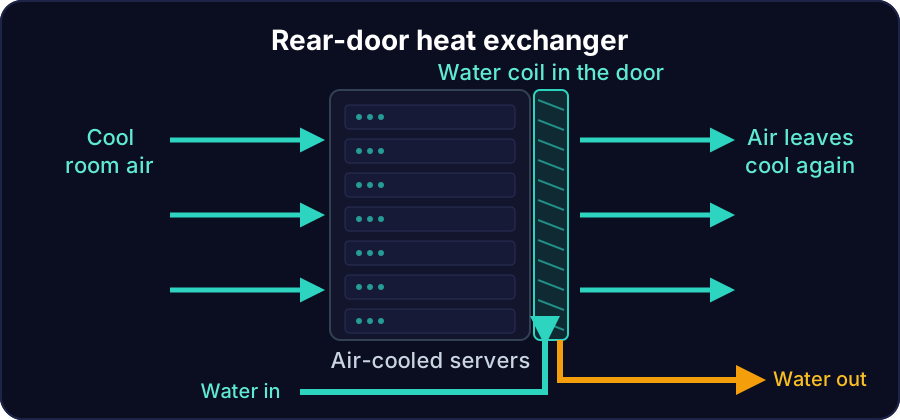
A water coil replaces the back door of the rack and cools the hot exhaust air before it reaches the room. The servers are still air cooled, so nothing changes inside the IT equipment. It is a good retrofit step for racks in the tens of kilowatts, but it does not solve the problem at 100 kW and above.
2. Direct-to-chip (cold plates)
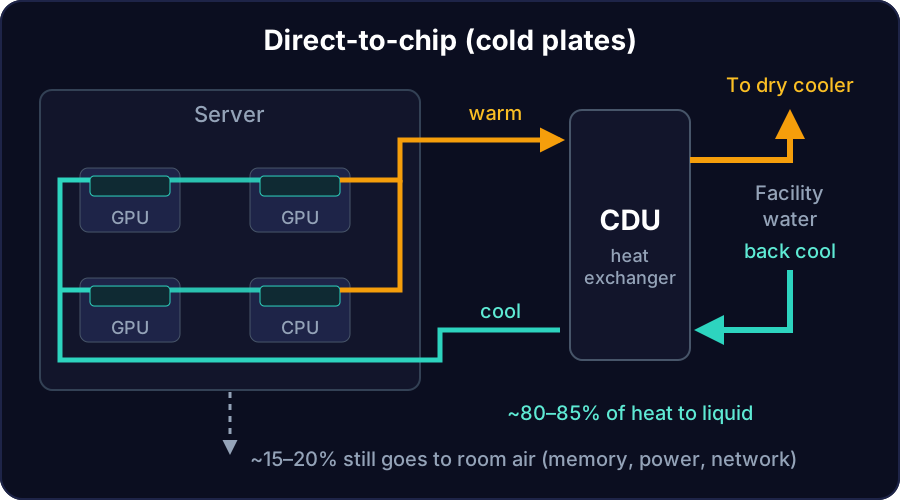
Small cold plates sit directly on the GPUs and CPUs, and a coolant loop carries the heat away. A coolant distribution unit (CDU) separates this clean, tightly controlled secondary loop from the building's facility water. This is the approach most new AI halls are built around. Cold plates do not catch everything, though: memory, power supplies and network gear still shed heat to air. Estimates for current AI racks put roughly 80 to 85 % of the heat into the liquid, which still leaves 15 to 20 kW of air-side heat per rack. That is more than a whole legacy rack, so the room air system does not disappear.
3. Immersion cooling
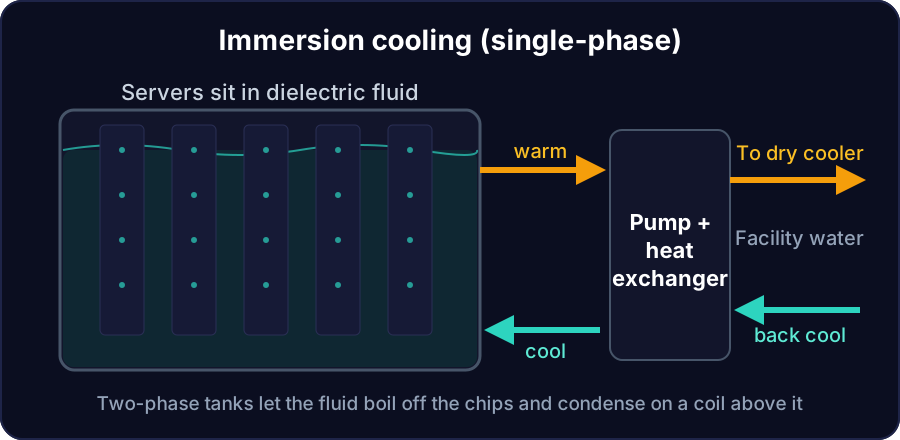
The servers sit in a tank of dielectric fluid. Single-phase systems pump the fluid through a heat exchanger; two-phase systems let it boil off the chips and condense on a coil. Immersion captures almost all of the heat, but it changes how the hardware is maintained, and many two-phase fluids are fluorinated chemicals that are under growing regulatory pressure. For now it remains a niche next to cold plates.
The Gulf twist: warm water is your friend
Here is the part that surprises many engineers. Chips are happy with surprisingly warm coolant. ASHRAE's liquid cooling guidelines group facility water into classes from W17 up to W45 and beyond, named after the maximum supply temperature in °C, and many cold-plate systems are designed for W32 or W40 water.
ASHRAE W classes at a glance
ASHRAE's data centre committee (TC 9.9) sorts liquid-cooled IT equipment by the warmest facility water it can accept, measured where that water enters the CDU. The number in each class name is that maximum supply temperature in °C. The 2021 fifth edition of ASHRAE's Thermal Guidelines for Data Processing Environments renamed the older W1 to W5 classes this way and added W40.
| Class | Max facility water supply | What usually makes the water |
|---|---|---|
| W17 | 17 °C (63 °F) | Chillers, with free cooling only in cold weather. In the Gulf, chillers run almost all year. |
| W27 | 27 °C (81 °F) | Chillers plus cooling-tower free cooling. Gulf free cooling is mostly limited to winter. |
| W32 | 32 °C (90 °F) | Cooling towers, with chillers as back-up. Dry coolers can do it on winter days and cool nights. |
| W40 | 40 °C (104 °F) | Cooling towers or dry coolers, with chiller trim. Dry coolers cover most hours outside peak summer. |
| W45 | 45 °C (113 °F) | Dry coolers or cooling towers. Chillers are needed only on the hottest afternoons. |
| W+ | Above 45 °C (113 °F) | Dry coolers almost all year. Warmer return water helps heat reuse where there is a heating demand, which is rare in the Gulf. |
Two things to keep in mind. The class describes the building side of the CDU; the coolant at the chips runs a few degrees warmer. And the class is a design target, not a promise: the IT vendor's specification sets the real limit for each rack.
Read more from ASHRAE: the Datacom Series (Thermal Guidelines and Liquid Cooling Guidelines), the free TC 9.9 white paper Emergence and Expansion of Liquid Cooling in Mainstream Data Centers (PDF), and the Thermal Guidelines reference card (PDF).
That matters enormously in the Gulf. Conventional chilled water at 6 to 7 °C needs chillers running all year in Dubai. Water at 32 to 40 °C can often be made by dry coolers alone, with no compressors running. A dry cooler can never cool water below the outdoor air temperature: in practice the water leaves about 5 to 8 K warmer than the outdoor dry bulb (the "approach"). Turned around, the outdoor air has to be at least that much cooler than the water you want to make:
- W32 (32 °C water): outdoor air at or below roughly 24 to 27 °C. That covers most of the winter months and many nights.
- W40 (40 °C water): outdoor air at or below roughly 32 to 35 °C. That covers a large share of the year's hours outside the peak of summer.
- On the hottest summer afternoons, chillers or trim cooling still have to step in, so they cannot be designed out, only run far less.
Cooling towers can do better than dry coolers, because evaporation lets them approach the wet-bulb temperature instead of the dry bulb. But Dubai's summer wet bulb sits around 29 to 30 °C, and towers consume water, which brings its own problem.
Even where chillers are needed, warmer water helps. As a rough rule of thumb, every 1 K rise in chilled water temperature saves a few per cent of chiller energy, because the compressor has less lift to do. A chiller at 0.6 kW/TR runs at a COP of about 5.9; push the efficiency to a COP of 7 and you are at about 0.50 kW/TR. The COP, EER and SEER converter switches between these ratings in one step.
Water: the resource nobody can ignore
Cooling towers are efficient because they evaporate water, and evaporating water takes a lot of energy. Every kWh of heat rejected by evaporation boils off about 1.5 litres of water, before you add blowdown. If a 100 MW campus rejected all of its heat through cooling towers, that would be around 3,600 m³ of water evaporated a day, plus roughly another third again in blowdown at typical cycles of concentration.
In a region where most potable water comes from desalination plants, that is a serious cost and a sustainability question. Expect Gulf AI campuses to lean on a mix of dry coolers for warm-water loops, hybrid or adiabatic coolers that only spray water on the hottest days, and treated sewage effluent (TSE) rather than potable water for any evaporative cooling, an approach the region's district cooling plants already use.
Humidity and condensation still matter
The air side of a liquid-cooled hall is smaller, but it is not trivial, and in a humid coastal city it needs care. ASHRAE's recommended envelope for IT equipment inlet air is 18 to 27 °C with a dew point no higher than 15 °C. Compare that with a humid August day in Dubai: at 35 °C and 60 % RH the dew point is about 26 °C. Any outdoor air that leaks in carries a lot of moisture.
Two practical rules follow:
- Keep every liquid loop above the room dew point. A hall held at 27 °C and 50 % RH has a dew point of about 15.7 °C. A W17 or warmer loop sits safely above it; an old 7 °C chilled water branch inside the white space does not. Check your own conditions with the psychrometric calculator.
- Treat the outdoor air separately. Halls need a small amount of fresh air for pressurisation and occupants. Dehumidify it in a dedicated unit before it enters, rather than letting the CRAH coils fight latent load. The DOAS sizing calculator shows what a dedicated outdoor air unit has to do in Gulf conditions.
A checklist for MEP engineers starting an AI hall
- Get the liquid fraction from the IT vendor early. The split between liquid and air heat sets the size of both systems. Do not assume 100 % liquid.
- Pick the facility water class with the operator. W32 or W40 unlocks free cooling; W17 or W27 keeps chillers in the loop all year.
- Design the CDU and secondary loop for clean, stable water. Cold plates have fine channels. Filtration, water treatment and leak detection are not optional extras.
- Plan for transient loads. AI training jobs can swing a hall's load by tens of per cent in seconds, so pumps, valves and controls must respond quickly.
- Size for heavy rack weight and pipe routes. Liquid-cooled AI racks can exceed 1.3 tonnes, and every rack needs supply and return connections.
- Count the water, not just the power. Report water usage effectiveness (WUE) alongside power usage effectiveness (PUE), and choose heat rejection with the local water source in mind.
The bottom line
AI has pushed rack loads past what air can handle, and liquid cooling is now the default for new high-density halls. For Gulf engineers, the opportunity is in the details: warm facility water that lets dry coolers do most of the work, a careful split between liquid and air loads, tight humidity control in a coastal climate, and heat rejection that does not burn through desalinated water. The data halls going up in Abu Dhabi and Dubai over the next few years will show whether we get those details right.
Want to run the numbers for your own project? Start with the liquid flow convertor for coolant flow, the psychrometric calculator for dew points, and browse the rest of the HVAC tools.