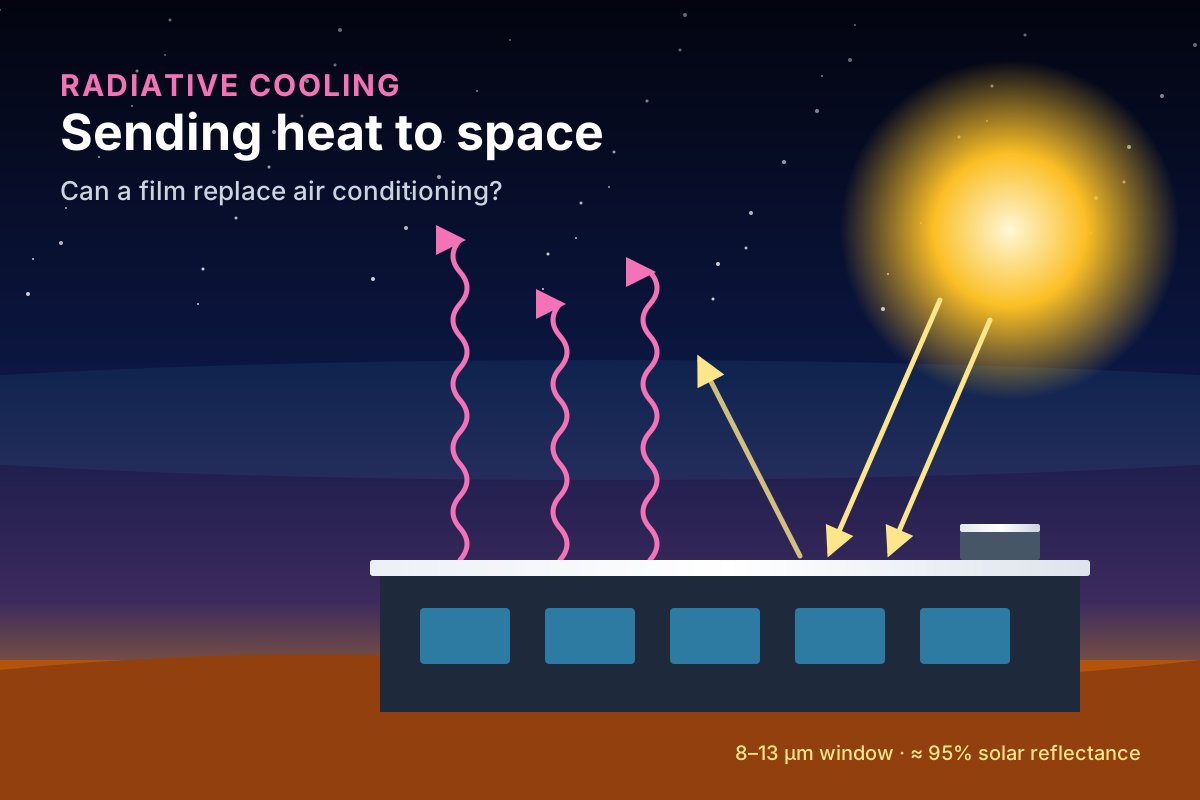
A video doing the rounds online calls it "Japan's new invention that could make the air conditioner obsolete"[1]. The invention is SPACECOOL, a thin radiative cooling film that reflects sunlight and sends heat out into space through the sky's infrared window, with no electricity. It is real, it works, and the field tests are impressive in the right places. It will not replace your chiller. This article pulls together what the manufacturer claims, what the independent science says, and what that means for HVAC and MEP engineers working in hot, humid climates such as the Gulf.
The short answer
SPACECOOL is a passive daytime radiative cooling (PDRC) material. Under a clear sky it can keep a surface a few degrees below the surrounding air temperature even in direct sun, which ordinary paint cannot do. In published field tests it has cut air-conditioning energy by about 8 to 10% in conventional buildings and by about 29 to 49% in lightweight container houses[13][16][17]. Those numbers come almost entirely from the company and its project partners. The physics caps the cooling it can give at roughly 150 W/m² in a dry climate and less than 50 W/m² in a humid tropical one[28], which is a small fraction of a typical building's cooling load. So it is a load reducer, not a replacement for air conditioning.
What SPACECOOL is and who makes it
SPACECOOL Inc. is a Tokyo-based start-up that grew out of research at Osaka Gas. The radiative cooling project began inside Osaka Gas in 2017, built on photonic crystal work that its current CEO, Masahiro Suemitsu, had been doing since 2013 and for which he received a doctorate from Kyoto University in 2019[2]. The company was set up in April 2021 with investment from the venture firm WiL and Osaka Gas[2], began commercial sales in May 2022[3], and Suemitsu became CEO in April 2024[4]. In 2025 the material won the EXPO 2025 JPO-WIPO Award in the climate change category, from the Japan Patent Office and the World Intellectual Property Organization[5].
The product is sold in several forms: a self-adhesive film (white or silver), magnet sheets, tarpaulins and architectural membranes[6][9]. Here is what the manufacturer and its distributor publish:
| Property | Published value | Source |
|---|---|---|
| Solar reflectance (0.3–2.5 µm) | About 95% | Manufacturer[7][9] |
| Emissivity in the atmospheric window (8–13 µm) | About 95% | Manufacturer[7][9] |
| Film thickness | About 0.11 mm (110 µm, ISO 4593) | Manufacturer and distributor[8][9] |
| Surface temperature below ambient air | 2–6 °C; up to 6 °C in an Osaka Gas test in 2020 | Distributor and developer[9][11] |
| Cooling power | 70–100 W/m² in one listing, 120–150 W/m² in another | Reseller and distributor[10][9] |
| Weathering | Equivalent to 15 years in xenon-lamp testing, "not guaranteed"; a high-durability grade was released in March 2025 | Manufacturer and trade press[8][12] |
| Price | Not published; sold through partner dealers on quotation | Search of manufacturer and dealer pages |
Two things stand out. First, the two cooling-power figures disagree with each other, and the higher one sits right at the theoretical ceiling for an ideal material under a dry sky (more on that below), so treat it as a best case. Second, the optical properties have been measured independently: Germany's national metrology institute (PTB) characterised a SPACECOOL sample as one of four benchmark materials in the EU PaRaMetriC project, reporting near-normal emissivities of 0.9 or more for the samples it measured[32][33]. Independent confirmation that the surface emits strongly in the infrared is useful. It is not the same as independent confirmation of the energy savings.
How radiative cooling works
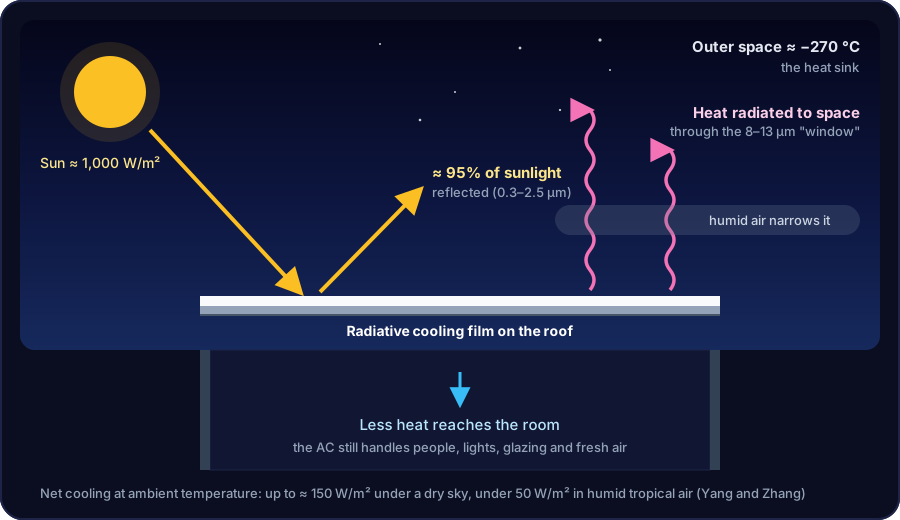
Every surface radiates heat as infrared light. Most of that radiation is absorbed by water vapour and carbon dioxide in the air and sent back down, so on balance a roof facing the sky loses little. Between about 8 and 13 µm, though, the atmosphere is fairly transparent. Radiation in that band passes straight out to space, which is at about −270 °C. This is why a clear night sky chills a car windscreen below the air temperature.
Doing the same in daylight is harder, because the sun delivers around 1,000 W/m² at noon and a good emitter only sheds around 100 W/m². If the surface absorbs even 10% of the sunlight, the solar gain wipes out the cooling. A daytime radiative cooler therefore needs two properties at once:
- Very high solar reflectance (0.3–2.5 µm), so almost no sunlight is absorbed.
- Very high emissivity in the 8–13 µm window, so heat leaves to space faster than the air and sun can put it back.
Stanford researchers first showed that this was possible in 2014. Their multilayer photonic film stayed 4.9 °C below the air temperature under more than 850 W/m² of sunlight and removed 40.1 W/m² of heat at ambient temperature[27]. SPACECOOL is one of the first products to make that idea cheap and robust enough to stick on a roof. An independent measurement paper describes it as a self-adhesive multilayer silver-polymer film[32]: in plain terms, a silver mirror for sunlight behind a polymer that glows strongly in the infrared.
The physics ceiling: how much cooling is on offer
This is the number most headlines leave out. A review by Yang and Zhang at Columbia University puts the net cooling power of an ideal radiative cooler at about 150 W/m² at an ambient temperature of 20–30 °C under a dry atmosphere, falling to under 50 W/m² in warm tropical regions where humidity is above 60%[28]. A Singapore study arrived at a similar limit of around 35 W/m² for its tropical daytime conditions[29].
Put that in HVAC terms. One ton of refrigeration is 3.517 kW. A 1,000 m² roof covered in a perfect cooler would give:
- Dry desert sky: 1,000 × 150 = 150 kW, about 43 TR, at best and only around solar noon on a clear day.
- Humid coastal sky: 1,000 × 35 to 50 = 35–50 kW, about 10–14 TR.
For comparison, a common Gulf rule of thumb for offices is around one ton of refrigeration per 25 to 30 m² of floor, so a 1,000 m² single-storey office needs something like 33 to 40 TR, and a multi-storey building has the same roof area serving many floors. The film can also only remove heat from the surface it is stuck to. It does nothing about the outdoor air you bring in, the people inside or the sun through the windows. That is why no serious source claims it can replace an air conditioner, and why the useful question is how much of the roof and wall heat gain it can cut.
What the field tests show
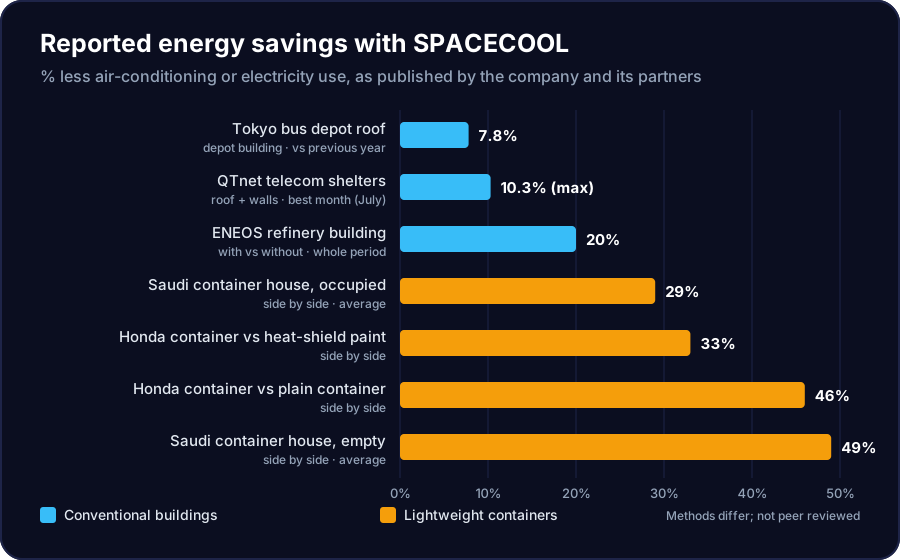
SPACECOOL and its partners have published a long list of demonstrations. The table below lists the ones with numbers, who measured them and how. Read the "method" column carefully: a before-and-after comparison against last year's bills is much weaker evidence than two identical buildings side by side.
| Site | What was covered | Method | Reported result |
|---|---|---|---|
| Toei bus depot, Shinagawa, Tokyo (May–Sep 2024) | Roof waterproofing sheet made with SPACECOOL | Depot electricity vs the previous year; roof surface vs a heat-shield sheet on part of the same roof | Electricity down 6.7% (Jul), 8.7% (Aug), 8.4% (Sep), 7.8% average; August roof surface about 7 °C cooler on average, up to about 16 °C[13][14] |
| QTnet telecom shelters, Kyushu (2023–2025) | Roof and all walls | Trial Sep 2023, then year-long electricity monitoring | Inside temperature down up to 5.3 °C (3.6 °C average); AC set point raised up to 4 °C; electricity down up to about 10% (10.3% in July); fewer equipment alarms[15][16] |
| Container houses, Saudi Arabia (2024) | Roof and walls of 12 × 3.6 × 3.7 m units | Two units side by side, one with and one without; calculated by Saudi government agencies and Red Sea Global | AC energy down 29% average (37% max) when occupied; 49% average (64% max) when empty[17][18] |
| Honda-affiliated factory, Yorii, Japan | Container house | Side-by-side containers | Power use down 46% vs a plain container and 33% vs one with heat-shield paint[19] |
| ENEOS Sakai refinery, Japan | Building with AC | Monitoring with and without the material | AC energy down about 21% on sunny days and about 20% over the whole period[20] |
| Gas Pavilion, Expo 2025 Osaka | Outer membrane of the pavilion | On-site measurements plus CFD simulation with Ritsumeikan University | Heat load down about 40% (company-reported; the full report was not found)[21][22] |
| Gas engine heat pump outdoor units ("COOL WING", Osaka Gas) | Stainless hood lined with SPACECOOL over the heat exchanger | Demonstration test | Condenser air intake up to 3.5 °C cooler; effect depends on operation and site[23] |
A few honest observations on this evidence:
- Almost all of it is self-reported. The Tokyo transport bureau published its own results[13], and the Saudi figures were calculated by the Saudi partners[17], but none of these tests has appeared in a peer-reviewed journal that we could find. A 2025 article in the REHVA Journal on radiative cooling of outdoor units and buildings was co-written by SPACECOOL's regional director of business development[26].
- The Tokyo electricity figure compares 2024 with 2023. Weather, occupancy and operation change from year to year, so the 7.8% is indicative rather than a controlled result. The roof surface temperature comparison, measured on the same roof at the same time, is the stronger finding.
- Percentages depend on the baseline. Honda's container saved 46% against a plain box but 33% against one with heat-shield paint[19]. Against a modern white cool roof, the gain would be smaller again.
- The biggest numbers come from the flimsiest buildings. That is not a coincidence, as the next section shows.
Why the results range from 8% to 49%: insulation
The film acts on the outside surface. How much of that surface heat reaches the room depends on how well the roof is insulated. The sol-air temperature method from the heat gain chapter of ASHRAE Handbook—Fundamentals shows the effect with simple arithmetic.
Take a flat roof in Dubai at noon on an ASHRAE 0.4% design day: 43.3 °C outdoor air[37], about 950 W/m² of sun on the roof, the usual outside surface coefficient of 17 W/m²·K and a 3.9 K long-wave correction for a horizontal surface. The sol-air temperature is Tsol = To + αI/ho − 3.9, where α is the solar absorptance. Room air is 24 °C.
| Roof finish | Solar absorptance α | Sol-air temperature | Heat in, insulated roof (U = 0.3 W/m²·K) | Heat in, bare metal sheet (U ≈ 5 W/m²·K) |
|---|---|---|---|---|
| Dark membrane | 0.85 | 86.9 °C | 18.9 W/m² | 315 W/m² |
| Aged white cool roof | 0.30 | 56.2 °C | 9.6 W/m² | 161 W/m² |
| Radiative cooling film | 0.05 | 42.2 °C | 5.5 W/m² | 91 W/m² |
For a 1,000 m² roof, switching from a dark roof to the film saves about 13 kW (3.8 TR) on the insulated building but about 224 kW (64 TR) on the bare metal one. Against an aged white roof, the film saves about 4 kW on the insulated roof and about 70 kW on the bare one.
These are steady-state peak figures built on stated assumptions, not measurements, and the standard sol-air correction does not credit the film's extra emission through the sky window. In a dry sky that would add some more cooling. In humid Gulf summer air it adds little, which is why the film's sol-air temperature here sits just below the outdoor air. The pattern matches the field tests: modest savings on insulated buildings, large ones on containers, tents, telecom shelters and site cabins. You can check your own roof build-up with the U-value calculator.
The Gulf question: does radiative cooling work in humid heat?
Most of the published SPACECOOL tests are from Japan, and Japanese summers are humid. The Gulf coast in late summer is more humid still. ASHRAE's 0.4% dehumidification design dew point is 29.1 °C for Dubai International and 29.2 °C for Abu Dhabi, against 26.0 °C for Tokyo Haneda[37]. Warm Gulf sea water feeds that moisture, and coastal relative humidity can climb above 90% on some days[39].
Water vapour matters because it absorbs and re-emits infrared, which partly closes the 8–13 µm window. A study of daytime radiative cooling in warm, humid Okayama, Japan, found that performance drops once precipitable water vapour rises above about 20 mm[30]. Researchers designing an improved cooler explain that an early field test in Hong Kong failed to cool below ambient for this reason, while noting that dry regions, the Middle East among them, have much more transparent skies[31].
For the Gulf this splits into two cases:
- Inland and in the drier months (inland sites such as central Saudi Arabia, and the cooler months on the coast), the sky window is relatively open and the film should perform close to its best. Riyadh's ASHRAE design dew point is only 17.2 °C[37].
- On the coast in July to September, when Dubai and Abu Dhabi are at their most humid, expect the sub-ambient effect to shrink towards the tropical figure of under 50 W/m²[28]. The material still reflects about 95% of the sun, so it will still run much cooler than a dark roof. It may simply sit at or slightly above air temperature instead of well below it.
Two data points from the region are encouraging. The Saudi container test was carried out with Red Sea Global, the developer of resorts on the country's Red Sea coast[17][40], and still reported a 29% average saving when occupied. SPACECOOL also covered the roof of a roughly 3,200 m² tennis court tent at the Emirates Palace Mandarin Oriental in Abu Dhabi in 2025[24], and lists the UAE among its markets[25]. No measured results from a UAE installation had been published at the time of writing.
Dust, dirt and durability
The film's whole advantage rests on keeping solar reflectance near 95%. Lose a few points and most of the sub-ambient benefit is gone, because the sun delivers ten times more energy than the film can radiate away. In the Gulf, dust is the obvious risk.
- Research on cool-roof coatings shows that soiling is the main reason solar reflectance falls over time, and that cleaning restores most of it, but only temporarily[35].
- Laboratory radiative coolers designed for durability have kept reflectance losses below 1% after accelerated tests equivalent to three years of soiling and one year of sun[34]. That is a research coating, not SPACECOOL, and accelerated tests are not the same as Gulf sandstorms.
- SPACECOOL states a weathering performance equivalent to 15 years in xenon-lamp testing but says this is not guaranteed[8], and launched a high-durability grade in 2025[12].
We found no multi-year field data on SPACECOOL's reflectance in a dusty desert climate. Until that exists, plan for regular washing, ask the supplier for aged reflectance data, and do not bank lifetime savings on day-one optical values.
Radiative cooling film vs cool roof paint
Dubai's Al Sa'fat green building system already asks for a roof solar reflectance index (SRI) above 78 on flat and low-slope roofs[38], so most new Dubai buildings start with a reasonably cool roof. Here is how the options compare:
| Dark roof | White cool roof coating | Radiative cooling film (PDRC) | Extra insulation | |
|---|---|---|---|---|
| Solar reflectance | Typically under 20% | Roughly 65% or more to reach SRI 78; lower when dirty | About 95% (manufacturer) | Not applicable |
| Can go below air temperature in sun | No | Rarely | Yes, under a clear and fairly dry sky | No |
| Helps an insulated building | Baseline | Some | Some more | Only up to a point |
| Helps a lightweight structure | Baseline | A lot | The most | A lot, if there is room for it |
| Main risks | Heat gain | Soiling | Soiling, glare from the silver grade, unproven long-term life, cost | Space, weight, condensation detailing |
Other radiative cooling films are on the market too. 3M, for example, sells a cooling film for vehicles and trailers that it rates at more than 85% solar reflectance and more than 91% emissivity in the atmospheric window[41]. On published figures SPACECOOL reflects more sunlight than that, but no independent side-by-side field comparison of commercial films has been published that we could find.
Where it makes sense for MEP engineers
Based on the physics and the published tests, these are the applications where a radiative cooling film is most likely to pay off:
- Air-cooled condensing units and outdoor units. A cooler intake means a lower condensing temperature and a better COP. Osaka Gas measured up to 3.5 °C lower intake air with its COOL WING hood[23]. Shading is often the cheaper first step; check the efficiency effect with the COP, EER and SEER converter.
- Telecom shelters, electrical kiosks and battery or inverter enclosures, where the load is mostly solar, the set point can float up, and fewer high-temperature alarms are worth money[16].
- Portable cabins, site offices and labour accommodation containers, the clearest win in the published data[17][19].
- Tents, shade structures and car park canopies, using the membrane or tarpaulin versions, where the people below are directly exposed to the hot underside.
- Warehouses and factories with uninsulated metal roofs that are expensive to insulate.
It makes less sense on a well-insulated, glazed office tower, where the roof is a small share of the load, and in climates with real heating demand, where a permanently cold roof adds a winter heating penalty[36]. That second point rarely matters in the Gulf.
Questions to ask before you specify it
- What are the measured solar reflectance and 8–13 µm emissivity, to which standard, and what are they after one, three and five years outdoors?
- Is there test data from a hot, humid, dusty site, and who measured it?
- Was the baseline a dark roof, a white roof or last year's bills?
- What warranty is offered on adhesion and reflectance, and what is the cleaning regime?
- What is the installed cost per m², and what payback does that give against a white coating or extra insulation on your actual roof U-value?
- Is the fire rating suitable for the roof or façade under local civil defence rules?
- Will the silver grade cause glare for neighbours or aviation?
When you have the supplier's numbers, put the reduced roof heat gain into a proper load calculation with the HVAC unit sizing calculator rather than applying a headline percentage.
Frequently asked questions
Can SPACECOOL replace air conditioning?
No. It reduces the heat entering through the surfaces it covers, and the physics caps that at around 150 W/m² in dry air and under 50 W/m² in humid tropical air[28]. A building's fresh air, people, lighting and glazing loads are untouched. Published tests show air-conditioning savings of about 8 to 49%, depending mostly on how well insulated the building was.
How does a radiative cooling film work?
It reflects about 95% of sunlight and emits heat strongly at 8–13 µm, a band of infrared that passes through the atmosphere to space[7]. Because it loses heat to the cold of space faster than the sun and air can add it, the surface can stay a few degrees below air temperature even in direct sunlight.
Does radiative cooling work in humid climates like Dubai?
Partly. Humid air absorbs infrared and narrows the window to space, so the below-ambient effect shrinks in humid conditions[30]. The high solar reflectance still keeps the surface far cooler than a dark roof. Expect the best results inland and in the drier months, and the weakest on the coast in late summer.
How much cooler does SPACECOOL get than the air?
The manufacturer's distributor quotes 2 to 6 °C below ambient[9], and Osaka Gas reported up to 6 °C in direct sun in its 2020 test[11]. Compared with a dark roof, the difference in surface temperature is far larger: in Tokyo the roof averaged about 7 °C cooler than a heat-shield sheet, and up to about 16 °C[14].
Is radiative cooling film better than white roof paint?
On optics, yes: it reflects more sunlight and can go below air temperature, which white paint rarely does. Honda's test found 33% lower power use than a container with heat-shield paint[19]. Whether it is worth the extra cost depends on the building. On a well-insulated roof the extra saving over a good white roof is small.
How long does SPACECOOL last?
SPACECOOL quotes weathering equivalent to 15 years in xenon-lamp tests, without a guarantee[8], and released a high-durability grade in 2025[12]. Independent multi-year data from dusty desert sites has not been published yet.
Is SPACECOOL available in the UAE?
The company lists the UAE among its markets and has an installation on a tennis court tent at Emirates Palace in Abu Dhabi[24][25]. We did not find a named UAE distributor or published prices; SPACECOOL sells through partner dealers.
The bottom line
SPACECOOL is a genuine piece of materials science. It does something no paint can do, and the people behind it have taken it from a lab idea to a product used by Honda, Tokyo's transport bureau and a Saudi giga-project in under five years. But "could make the air conditioner obsolete" is the wrong way to think about it. The right way is as a very good roof and wall finish that removes part of the solar load, most valuable on lightweight structures and outdoor equipment, and least valuable on buildings that are already well insulated. In the humid Gulf summer it will work less well than in Japan's best tests, and nobody has yet published how it holds up after several years of dust. Ask for the data, model it against your own roof, and treat any single headline percentage with care.
The sol-air worked example uses stated assumptions (solar 950 W/m², ho = 17 W/m²·K, absorptances as listed, steady state, room at 24 °C). Field results are as reported by the parties named; most have not been independently peer reviewed.
References
Numbers in the text link straight to the source. Sources marked Japanese are in Japanese; figures were taken from their published text.
The video and the company
- YouTube video: “Japan’s New Invention That Could Make The Air Conditioner Obsolete”. https://www.youtube.com/watch?v=JLO-blyH3b4
- SPACECOOL Inc., Members page: company history and the CEO’s research background (Japanese). https://spacecool.jp/members/
- SPACECOOL Inc., Official sales of SPACECOOL begin on 12 May 2022 (Japanese press release). https://spacecool.jp/news/post-255/
- SPACECOOL Inc., SPACECOOL INC. announces the change of CEO (1 April 2024). https://spacecool.jp/en/news/20240401/
- Ministry of Economy, Trade and Industry (Japan), Winners of the EXPO2025 JPO-WIPO Award (26 September 2025). https://www.meti.go.jp/english/press/2025/0926_002.html
- SPACECOOL Inc., Product page: Film. https://spacecool.jp/en/product/film/
- SPACECOOL Inc., SPACECOOL’s Technology (reflectance and emissivity). https://spacecool.jp/en/technology/
- SPACECOOL Inc., Frequently asked questions (thickness, weathering). https://spacecool.jp/en/faq/
- Nagase & Co., SPACECOOL radiative cooling material (distributor product page). https://www.nagase.com/services/development/spacecool-heat-dissipation-film
- Datsutanso Keiei .com, SPACECOOL product listing (Japanese). https://de-denkosha.co.jp/datsutanso/product/spacecool/
- Daigas Group (Osaka Gas), SPACECOOL: new zero-power cooling material releasing heat into space. https://www.daigasgroup.com/en/rd/topic/1768556_56103.html
- MONOist (ITmedia), High-durability SPACECOOL film released, March 2025 (Japanese). https://monoist.itmedia.co.jp/mn/spv/2503/04/news061.html
Field tests and installations
- Bureau of Transportation, Tokyo Metropolitan Government, Results of the demonstration using the radiative cooling material SPACECOOL (21 May 2025, Japanese). https://www.kotsu.metro.tokyo.jp/pickup_information/news/others/2025/otr_p_2025052112045_h.html
- SPACECOOL Inc., Joint demonstration with the Tokyo Bureau of Transportation confirms reduced air-conditioning load (21 May 2025, Japanese). https://spacecool.jp/news/20250521/
- SPACECOOL Inc., SPACECOOL adopted for QTnet telecom buildings: inside temperature down up to 5.3 °C (2 April 2024, Japanese). https://spacecool.jp/news/20240402/
- SPACECOOL Inc., Electricity use at telecom buildings cut by up to about 10% (16 July 2025, Japanese). https://spacecool.jp/news/20250716/
- SPACECOOL Inc., Saudi government agencies, Red Sea Global and Zamil Group report average 29% air-conditioning energy reduction in portable houses (6 February 2025). https://spacecool.jp/en/news/20250206/
- Government of Japan (KIZUNA), Innovative zero-energy radiative cooling material at Expo 2025 (April 2025). https://www.japan.go.jp/kizuna/2025/04/zero-energy_radiative_cooling_material.html
- SPACECOOL Inc., Demonstration experiment at Honda’s affiliated factory. https://spacecool.jp/en/news/conducted-a-demonstration-experiment-utilizing-the-radiation-cooling-material-spacecool-at-hondas-affiliated-factory/
- SPACECOOL Inc., Energy-saving effects demonstrated in field test at the ENEOS Sakai Refinery. https://spacecool.jp/en/news/energy-saving-effects-demonstrated-in-field-test-at-the-eneos-sakai-refinery/
- Masahiro Suemitsu (CEO, SPACECOOL), LinkedIn post on the Gas Pavilion verification with Ritsumeikan University. https://jp.linkedin.com/in/masahiro-suemitsu-2ab141b0
- Expo 2025 Osaka, Kansai, Osaka Gas Co., Ltd., Decarbonisation Category (PDF). https://www.expo2025.or.jp/en/wp-content/uploads/sites/2/2025/10/1a1ac68e3ebcf68dc9b9477574bffcfc.pdf
- Osaka Gas, COOL WING: radiative cooling option for gas engine heat pump outdoor units (press release, March 2024, Japanese). https://www.osakagas.co.jp/company/press/pr2024/1777757_56470.html
- SPACECOOL Inc., SPACECOOL material installed in tennis court tent at Emirates Palace Mandarin Oriental (30 July 2025). https://spacecool.jp/en/news/20250730/
- COP30 Japan Pavilion, SPACECOOL Inc. exhibitor page. https://www.copjapan.go.jp/cop30en/company/spacecool/
- REHVA Journal (August 2025), Passive radiative cooling: sending heat to space and reducing power consumption of active cooling. https://www.rehva.eu/rehva-journal/chapter/passive-radiative-cooling-sending-heat-to-space-and-reducing-power-consumption-of-active-cooling
Independent measurement and peer-reviewed research
- Raman, A. P., Abou Anoma, M., Zhu, L., Rephaeli, E. and Fan, S. (2014), Passive radiative cooling below ambient air temperature under direct sunlight, Nature 515, 540–544. https://doi.org/10.1038/nature13883
- Yang, Y. and Zhang, Y., Passive daytime radiative cooling: principle, application, and economic analysis (review, Columbia University). https://blogs.cuit.columbia.edu/yanggroup/files/2020/06/1-80.pdf
- Han et al. (2022), The criteria to achieving sub-ambient radiative cooling and its limits in tropical daytime, Building and Environment 221, 109281. https://ui.adsabs.harvard.edu/abs/2022BuEnv.22109281H
- Suichi, T. et al. (2018), Performance limit of daytime radiative cooling in warm humid environment, AIP Advances 8, 055124. https://pubs.aip.org/aip/adv/article/8/5/055124/923064/Performance-limit-of-daytime-radiative-cooling-in
- Radiative cooling with angular shields: mitigating atmospheric radiation and parasitic heating (2022), arXiv:2208.03797. https://arxiv.org/abs/2208.03797
- Adibekyan, A., Schumacher, F., Pattelli, L. et al. (2025), Emissivity and reflectivity measurements for passive radiative cooling technologies, International Journal of Thermophysics 46, 66. https://link.springer.com/article/10.1007/s10765-025-03532-6
- EURAMET, EURAMET project on passive radiative cooling technologies collaborates with SPACECOOL in Japan (November 2023). https://www.euramet.org/publications-media-centre/news/news/euramet-project-on-passive-radiative-cooling-technologies-collaborates-with-spacecool-in-japan
- Song, J. et al. (2022), Durable radiative cooling against environmental aging, Nature Communications 13. https://www.nature.com/articles/s41467-022-32409-7
- Buildings 12(7), 1002 (2022), review of cool-roof coating performance and soiling (MDPI). https://www.mdpi.com/2075-5309/12/7/1002
- Oak Ridge National Laboratory, The role of rooftop radiative properties in urban cooling and energy savings for different climate zones. https://impact.ornl.gov/en/publications/the-role-of-rooftop-radiative-properties-in-urban-cooling-and-ene/
Codes, climate data and other products
- ASHRAE Handbook—Fundamentals 2021, ch. 14 climatic design conditions (Dubai Intl, Abu Dhabi Intl, Riyadh, Tokyo Haneda), via ASHRAE Meteo. https://ashrae-meteo.info/v2.0/
- Dubai Municipality, Al Sa’fat roof solar reflectance index (SRI) compliance form, DM-DCLD-RD-DP32-5111-IC (PDF). https://www.dm.gov.ae/wp-content/uploads/2022/05/DM-DCLD-RD-DP32-5111-IC.pdf
- Gulf News, Why does the UAE get so humid without rain? The science explained. https://gulfnews.com/uae/weather/why-does-the-uae-get-so-humid-without-rain-the-science-explained-1.500623262
- Wikipedia, Red Sea Global. https://en.wikipedia.org/wiki/Red_Sea_Global
- 3M, 3M Cooling Film rail sell sheet (PDF). https://multimedia.3m.com/mws/media/2790869O/3m-cooling-film-rail-sell-sheet.pdf