Most smoking rooms are still sized with a rule of thumb: 10 air changes an hour, 30 L/s per person, or "exhaust 10% more than supply". Put those rooms through a simple mass balance and check them against the limits that Dubai Municipality, WHO, the EU, Japan, ACGIH and OSHA actually publish, and most of them fail, some by a factor of two and some by more than fifteen. This article walks through the regulations, the maths and the design traps, using the free Smoking Room Calculator to show every number.
Key findings
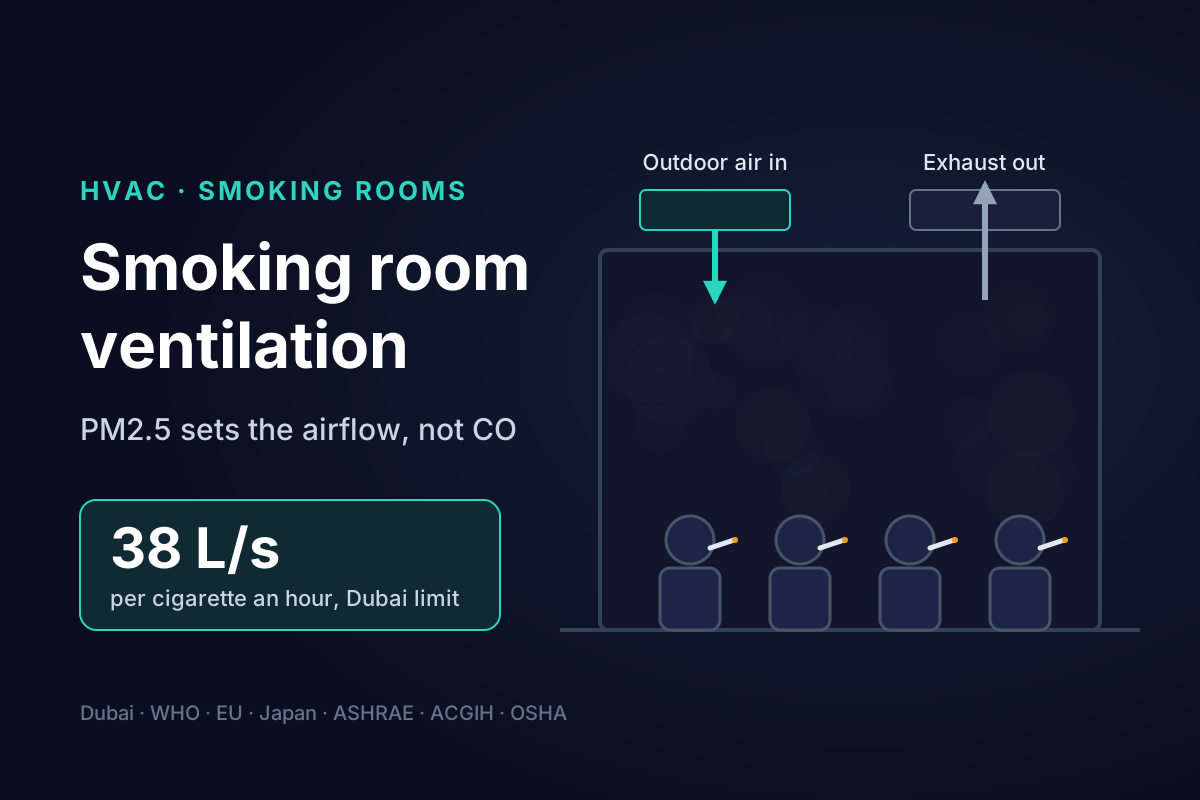
- Fine particles (PM2.5) set the airflow, not carbon monoxide. To meet Dubai's 100 µg/m³ PM2.5 limit, every cigarette smoked an hour needs about 38 L/s of clean air. Carbon monoxide needs about 0.5 L/s. A room sized on CO is under-ventilated by a factor of about 70.
- A CO₂ sensor will say the room is fine when it is not. At the airflow that just meets the PM2.5 limit, each smoker raises CO₂ by only about 70 ppm.
- The old 30 L/s per person for smoking lounges leaves PM2.5 near 250 µg/m³, two and a half times Dubai's limit and about 17 times WHO's 24-hour guideline.
- "Exhaust 10% more than supply" does not contain the smoke once the door opens. It gives about 0.03 m/s through a standard door, against the 0.2 m/s Japan requires.
- Staff are the forgotten occupants. ACGIH cut its nicotine limit 38-fold in 2025, and anyone working an 8-hour shift in the room needs several times the air a 1-hour visitor does.
- No code calls a smoking room safe. WHO, ASHRAE and the US Surgeon General all say only a smoke-free building fully protects people. A design that meets a limit is "within the code", not harmless.
Why smoking rooms are an HVAC problem nobody has solved
Many countries still allow designated smoking rooms in airports, hotels, offices, shisha cafés and cigar lounges. In the UAE they are permitted under the federal tobacco law and its executive regulation, and Dubai Municipality licenses them with its own technical guideline. Yet ask a room full of MEP (mechanical, electrical and plumbing) engineers how much air a smoking room needs and you will hear five different answers, because almost no current code gives an airflow. The codes give pollutant limits, pressure rules and separation rules, and leave the designer to connect them.
ASHRAE said this plainly when it removed smoking rates from its ventilation standard. Addendum o to ASHRAE 62-2001 states that specific ventilation rates for smoking areas "cannot be determined until cognizant authorities determine the concentration of smoke that achieves an acceptable level of risk". Two decades later, the City of Calgary still tells designers to fall back on ASHRAE 62-2001 for smoking rooms (Building Advisory B23-011, 2025), because the current standard does not give enough to design one.
The gap is easy to close with a mass balance. The rest of this article does exactly that.
The one equation behind every smoking room
Treat the room as well mixed and steady. Every milligram of pollutant the smokers release each hour has to leave in the extract air, so:
Croom = Csupply + G ÷ (Q × Ez)
- G is the emission rate (mg/h), from the number of cigarettes or cigars smoked each hour.
- Q is the clean air leaving the room (m³/h): the extract, made up of filtered outdoor supply plus any air drawn in from next door.
- Ez is the ventilation effectiveness from ASHRAE 62.1: about 1.0 for well-mixed ceiling supply and extract, lower for short-circuiting layouts.
Turn it round and you get the airflow a limit demands: Q = G ÷ (Climit − Csupply). The room reaches 95% of its steady level after three room time-constants (room volume ÷ extract rate), which in a typical smoking room is a few minutes. So the steady level is what people actually breathe.
What one cigarette or cigar puts into the room
These are environmental tobacco smoke values: the sidestream smoke from the burning tip plus the smoke the smoker breathes out, which is what ends up in the room air. They are the defaults in the calculator, and you can type your own.
| Pollutant | Per cigarette | Per large cigar | Source |
|---|---|---|---|
| Fine particles (PM2.5) | 13.7 mg | about 80 mg | Martin et al. 1997 (50 US brands); NCI Monograph 9 for cigars |
| Carbon monoxide (CO) | 55 mg (40–70) | about 1,100 mg | NCI Monograph 9, chapter 5 |
| Nicotine | 1.8 mg | about 1.2 mg | Nelson 1994, via Monograph 9 |
| Formaldehyde | 1.31 mg | about 6.5 mg (estimate) | Daisey et al. 1994, California ARB |
| Benzene | 0.41 mg | about 2 mg (estimate) | Daisey et al. 1994 |
A large cigar releases about 20 times the CO and 6 times the fine particles of a cigarette, and it burns for an hour or more. A cigar lounge is a different design problem from a cigarette room.
What the regulators actually say
The Smoking Room Calculator checks a room against nine sets of limits. Here is what each authority's own documents require, and, just as important, what they leave out.
UAE and Dubai Municipality
The UAE's Federal Law No. 15 of 2009 on tobacco control and its executive regulation, Cabinet Resolution No. 24 of 2013, allow designated smoking areas outside places such as health, education, worship and sports facilities, on condition that their ventilation and air conditioning are separate from the non-smoking areas.
Dubai Municipality's Technical Guideline for Compliance of Designated Smoking Areas (DM-HSD-GU118, December 2025) is the most detailed smoking-room document in this list. It asks for self-closing doors to non-smoking areas, smoking areas well away from main entrances, a fresh air unit that is never switched off during opening hours, two stages of filtration, and a commissioning and air balance report before the area opens. It then sets indoor limits, which the calculator uses: CO 25 ppm, CO₂ 5,000 ppm and PM2.5 100 µg/m³ as 1-hour values, benzene 17 µg/m³ over 8 hours, and a comfort band of 22.5 to 25.5 °C.
The permit guideline DM-HSD-GU70 adds the pressure rule: polluted air is exhausted straight outdoors, the exhaust is 10% more than the fresh air supply, and the smoking area sits 5 to 7 Pa below its neighbours.
What it leaves out: GU118 gives no airflow or air change rate, so the designer has to work back from the limits. And its PM2.5 limit is a 1-hour value that is more than six times WHO's 24-hour guideline.
World Health Organization
WHO publishes no smoking-room standard, because its position is that there should be no smoking rooms. The guidelines for Article 8 of the WHO Framework Convention on Tobacco Control state that approaches other than 100% smoke-free environments, "including ventilation, air filtration and the use of designated smoking areas (whether with separate ventilation systems or not), have repeatedly been shown to be ineffective".
WHO's air quality values are still the reference most countries use where there is no national one:
- PM2.5: 15 µg/m³ as a 24-hour mean and 5 µg/m³ as an annual mean (WHO Global Air Quality Guidelines, 2021).
- Carbon monoxide: 100 mg/m³ over 15 minutes, 35 mg/m³ over 1 hour and 10 mg/m³ over 8 hours (WHO indoor air quality guidelines, 2010), and 4 mg/m³ over 24 hours (2021).
- Formaldehyde: 0.1 mg/m³ over 30 minutes.
- Benzene: no safe level. 17 µg/m³ over a lifetime corresponds to an extra cancer risk of 1 in 10,000.
ASHRAE
ASHRAE 62.1 no longer gives a ventilation rate for smoking. What it does give are the separation rules: every space is classed as an environmental tobacco smoke (ETS) area or an ETS-free area, ETS-free areas are kept at a higher pressure than ETS areas, air from ETS areas is not recirculated or transferred to ETS-free areas, and each ETS area is signed. The last tabulated figure, carried in the ASHRAE 62 tables up to the 2001 edition, was 30 L/s of outdoor air per person for smoking lounges, and it was set for odour, not health.
ASHRAE's position document on environmental tobacco smoke (reaffirmed in 2023) goes further than the standard: the only way to avoid the health effects of ETS is to ban smoking inside and near buildings, and dilution, displacement ventilation and air cleaning cannot adequately control the health effects, even for the people inside a smoking room.
Japan
Japan is the one country that tests containment with a number. Under the amended Health Promotion Act, fully in force since April 2020, a smoking room must meet three technical standards (Ministry of Health, Labour and Welfare): air must flow into the room at 0.2 m/s or more across the open doorway, measured at the top, middle and bottom of the opening; the room must be enclosed by walls and a ceiling; and the smoke must be exhausted outdoors.
Japan's Act on Maintenance of Sanitation in Buildings sets the room air standards the calculator uses for Japan: CO 6 ppm (cut from 10 ppm in April 2022), CO₂ 1,000 ppm, suspended particles 0.15 mg/m³ and formaldehyde 0.1 mg/m³, with 18 to 28 °C and 40 to 70% relative humidity (MHLW).
European Union and United Kingdom
The EU's limits come from two directions. Worker exposure limits cover people in the room for a shift: CO 20 ppm over 8 hours and 100 ppm over 15 minutes (Directive 2017/164), formaldehyde 0.3 ppm and 0.6 ppm short-term (Directive 2019/983), and benzene 0.2 ppm from 5 April 2026 (Directive 2022/431). The recast ambient air directive (Directive 2024/2881) sets limits for 2030 that move towards WHO's: PM2.5 25 µg/m³ as a daily mean and 10 µg/m³ annually, CO 4 mg/m³ over 24 hours, and benzene 3.4 µg/m³ annually.
The UK's HSE EH40/2005 sets workplace exposure limits including CO 20 ppm, CO₂ 5,000 ppm, nicotine 0.5 mg/m³ and benzene 1 ppm. Smoking rooms in England are only allowed in a few places such as hotel bedrooms, care homes, prisons and offshore installations, and the Smoke-free (Exemptions and Vehicles) Regulations 2007 require such a room to be fully enclosed, with doors that close mechanically and a ventilation system that does not ventilate into any other part of the building.
United States: ACGIH and OSHA
OSHA's legal limits are 8-hour averages: CO 50 ppm, CO₂ 5,000 ppm, nicotine 0.5 mg/m³, formaldehyde 0.75 ppm and benzene 1 ppm (OSHA Table Z-1 and the formaldehyde and benzene standards). The ACGIH threshold limit values are stricter and are updated more often. The change that matters most for smoking rooms came in 2025: ACGIH cut its nicotine TLV from 0.5 to 0.013 mg/m³ (8 hours), with a 15-minute limit of 0.05 mg/m³. Benzene had already dropped to 0.02 ppm.
Hong Kong and China
Hong Kong's indoor air quality objectives (2019 revision, Good Class, 8-hour averages) include CO₂ 1,000 ppm, PM10 100 µg/m³ and formaldehyde 100 µg/m³ (EPD IAQ Information Centre). China's GB/T 18883-2022, in force since February 2023, sets PM2.5 at 50 µg/m³ (24 hours), CO at 10 mg/m³, formaldehyde at 0.08 mg/m³ and benzene at 0.03 mg/m³. Tobacco smoke particles are almost all smaller than 2.5 µm, so a PM10 limit acts on the same particles as a PM2.5 one.
The limits side by side
| Authority | Fine particles | Carbon monoxide | Who it protects |
|---|---|---|---|
| Dubai Municipality GU118 | PM2.5 100 µg/m³ (1 h) | 25 ppm (1 h) | Smoking-area users |
| WHO | PM2.5 15 µg/m³ (24 h), 5 (year) | 35 mg/m³ (1 h), 10 (8 h), 4 (24 h) | The general public |
| EU air quality, 2030 | PM2.5 25 µg/m³ (day), 10 (year) | 4 mg/m³ (24 h) | The general public |
| EU / UK workers | – | 20 ppm (8 h), 100 (15 min) | Workers |
| Japan | Suspended particles 0.15 mg/m³ | 6 ppm | Building occupants |
| China GB/T 18883 | PM2.5 50 µg/m³ (24 h) | 10 mg/m³ (1 h) | Building occupants |
| ACGIH TLV | Respirable dust 3 mg/m³ | 25 ppm (8 h) | Healthy workers |
| OSHA PEL | Respirable dust 5 mg/m³ | 50 ppm (8 h) | Workers (legal minimum) |
Note the spread. The workplace dust limits are written for inert dust, not tobacco smoke, and are 30 to 50 times Dubai's PM2.5 limit. Which column you design to decides whether a room needs 25 L/s or 250 L/s per cigarette.
Seven findings that should change how smoking rooms are designed
1. Fine particles set the airflow, not carbon monoxide
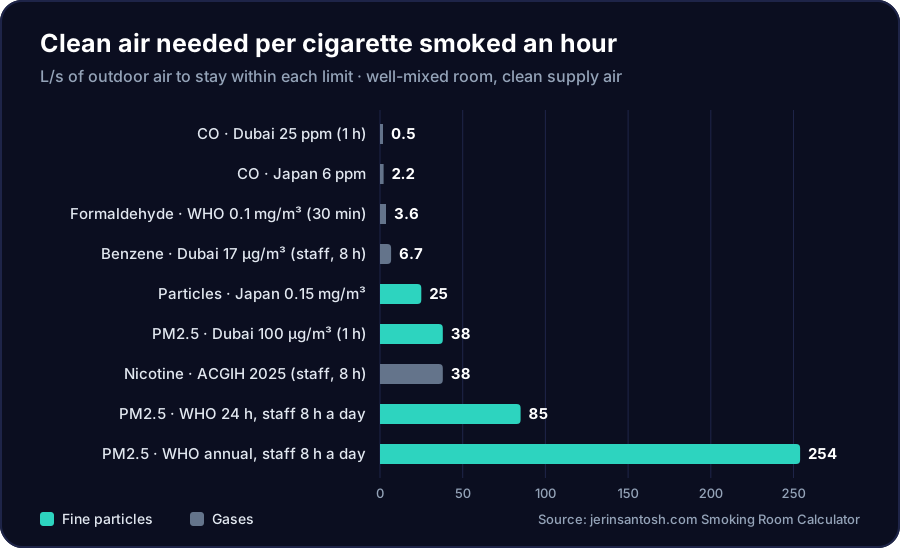
Run the equation for each pollutant and each limit, for one cigarette smoked per hour with clean outdoor supply air and a well-mixed room:
| Limit that must be met | Clean air per cigarette an hour |
|---|---|
| CO, Dubai 25 ppm (1 h) | 0.5 L/s |
| CO, Japan 6 ppm | 2.2 L/s |
| Formaldehyde, WHO 0.1 mg/m³ (30 min) | 3.6 L/s |
| Benzene, Dubai 17 µg/m³ (staff, 8 h) | 6.7 L/s |
| Particles, Japan 0.15 mg/m³ | 25 L/s |
| PM2.5, Dubai 100 µg/m³ (1 h) | 38 L/s |
| Nicotine, ACGIH 2025 (staff, 8 h) | 38 L/s |
| PM2.5, WHO 15 µg/m³ (24 h), staff in the room 8 h a day | 85 L/s |
| PM2.5, WHO 5 µg/m³ (year), staff in the room 8 h every day | 254 L/s |
Fine particles win by a wide margin. One smoker on two cigarettes an hour needs about 76 L/s of clean air just to stay within Dubai's limit. The same smoker needs about 1 L/s to stay within Dubai's CO limit. A room designed around CO, which many engineers instinctively reach for because it is the "toxic gas", is under-ventilated by a factor of about seventy.
2. CO and CO₂ sensors will tell you the room is fine
Demand-controlled ventilation is good practice almost everywhere, but it fails in a smoking room. A seated adult breathes out about 0.0052 L/s of CO₂. At the 76 L/s per smoker that just meets Dubai's PM2.5 limit, that raises CO₂ by only about 70 ppm above outdoor air. A CO₂ sensor would read around 490 ppm and turn the fans down, while the particles sit right at the limit. CO tells the same story: at that airflow it stays below 1 ppm per smoker.
If a smoking room's ventilation is controlled by anything, it should be a PM2.5 sensor, or a fixed rate set by the number of smoking positions.
3. The old 30 L/s per person leaves the air at 250 µg/m³
Thirty litres per second per person was the last smoking-lounge rate ASHRAE ever tabulated, and versions of it still circulate in specifications and in some free-zone policies. With everyone smoking two cigarettes an hour, the room settles at about 254 µg/m³ of PM2.5: two and a half times Dubai's limit, and about seventeen times WHO's 24-hour guideline. Even at one cigarette an hour per person it is 127 µg/m³, still over Dubai's limit.
4. Air changes are the wrong yardstick
"10 to 15 air changes an hour" is a common specification for smoking rooms. But smoke comes from smokers, not from the room's volume. Take a 20 m² room, 3 m high, with six cigarette smokers at two cigarettes an hour each:
- At 10 air changes an hour (167 L/s), PM2.5 settles at about 274 µg/m³.
- Meeting Dubai's 100 µg/m³ takes about 27 air changes an hour (456 L/s).
- Halve the room height and the air change rate doubles for the same result.
Design the airflow per smoking position, then check what air change rate it gives, never the other way round. The airflow converter switches the result between L/s, m³/h and cfm, and the Smoking Room Calculator shows the air change rate it gives.
5. "Exhaust 10% more than supply" does not contain the smoke
Every authority agrees the smoking room must be at a lower pressure than its neighbours. With the door shut, a 10% exhaust offset can hold the 5 to 7 Pa Dubai's permit guideline asks for, provided the room is well sealed. The problem is the door, which opens every time someone walks in or out.
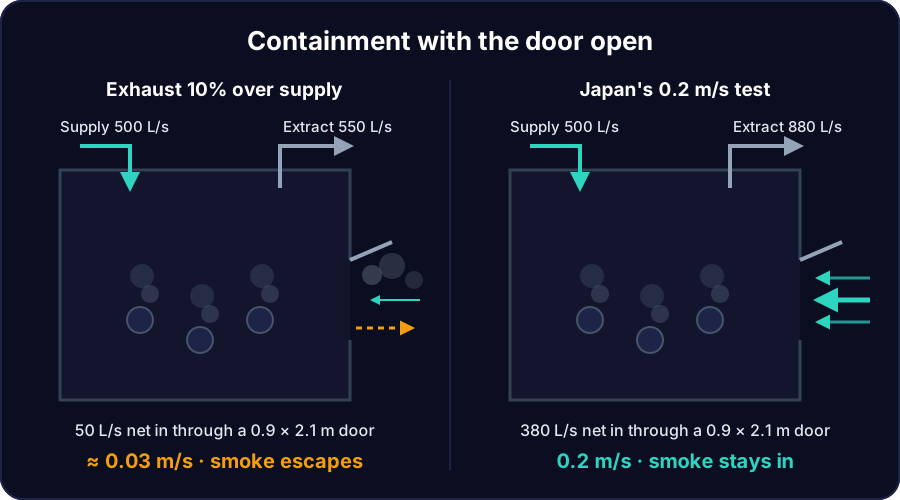
Once the door is open, the pressure difference collapses and the only thing keeping the smoke in is the net air flowing in through the opening. For a standard 0.9 × 2.1 m door (1.89 m²):
- A 50 L/s offset (10% of a 500 L/s supply) gives about 0.03 m/s through the opening. Body movement and the door's own swing push smoke out easily at that speed.
- Japan's 0.2 m/s needs about 380 L/s more extract than supply while the door is open.
That transfer air has to come from the next space, conditioned. The practical answers are a vestibule with two self-closing doors, a narrower doorway, strip curtains (a common way to reach 0.2 m/s in Japan), or a supply fan that turns down when the door opens. All of these are cheaper than the alternative, which is a building that smells of smoke.
6. Staff are the forgotten occupants
Most limits that smoking areas are judged against are short. Dubai's PM2.5 and CO limits are 1-hour values, and a visitor who stays 20 minutes is covered by them. The person who serves, cleans or supervises the room for an 8-hour shift is not.
For staff, the 8-hour and 24-hour limits apply, averaged over the time actually spent in the room. That is how OSHA's time-weighted average works (29 CFR 1910.1000(d)), and it is how the calculator handles every limit with an averaging time. The effect is large: to keep a worker within WHO's 24-hour PM2.5 guideline over an 8-hour shift takes about 85 L/s per cigarette an hour, more than twice Dubai's figure.
ACGIH's 2025 nicotine change makes it worse. At the old 0.5 mg/m³, nicotine needed about 1 L/s per cigarette an hour and never mattered. At 0.013 mg/m³ it needs about 38 L/s, the same as Dubai's PM2.5 limit. (Nicotine also sticks to walls and furnishings and is re-emitted later, so a well-mixed steady calculation is only a first estimate.) An employer with staff in a smoking lounge now has a nicotine exposure problem that few designs have accounted for.
7. Cigars and the Gulf climate multiply everything
One large cigar an hour needs about 222 L/s of clean air to meet Dubai's PM2.5 limit, almost six times a cigarette. With cigars, CO starts to matter too: Japan's 6 ppm limit needs about 44 L/s per cigar.
All of that air is 100% outdoor air, and in the Gulf it is expensive. Taking a common Dubai design point of 46 °C dry bulb and 29 °C wet bulb, and cooling it to 13 °C saturated:
- 76 L/s (one cigarette smoker, Dubai's PM2.5 limit) takes about 5.2 kW of cooling, roughly 1.5 tons of refrigeration.
- About 500 L/s (one cigarette smoker, WHO's annual PM2.5 guideline for full-time staff) takes about 35 kW, close to 10 tons, for a single smoker.
Heat recovery helps, but choose it carefully. Returning smoking-room air to other spaces is ruled out by ASHRAE, Dubai Municipality and the UAE regulation, and a rotary wheel's leakage and carry-over can bring exhaust back into the supply. Exchangers that keep the two airstreams fully apart, such as run-around coils and heat pipes, are the safer choice. The DOAS sizing calculator compares them at your design conditions.
What air cleaners can and cannot do
Smoke eaters and room air cleaners are often offered as a cheaper alternative to outdoor air. A HEPA filter does remove particles very well, and activated carbon takes out some nicotine, formaldehyde and benzene. But nothing in a portable cleaner removes CO or CO₂, a cleaner adds no outdoor air, and it does nothing for containment, because it moves air inside the room without changing the pressure. ASHRAE's position document, the US Surgeon General's 2006 report and WHO all conclude that air cleaning cannot make second-hand smoke safe. Treat a cleaner as a supplement to outdoor air, never as a replacement. The calculator includes an air cleaner, with MERV and HEPA filter classes, so you can see exactly how far it gets you.
A worked example with the Smoking Room Calculator
Open the Smoking Room Calculator with its default room: 20 m², 3 m high, six cigarette smokers at two cigarettes an hour, 400 L/s of tempered supply at 20 °C and 60% RH, and 500 L/s of extract.
- Room air: it settles at about 23.2 °C and 51% RH with the smokers' and the cigarettes' own heat, inside the 22.5 to 25.5 °C comfort band.
- PM2.5: about 91 µg/m³ in the breathing zone, at 30 air changes an hour. That is green against Dubai's 100 µg/m³, with little to spare. CO sits at 0.3 ppm and CO₂ at 484 ppm, both of which look perfect.
- Switch the standard to WHO: a visitor who spends an hour a day in the room stays green (76% of WHO's annual guideline), but the member of staff who spends 8 hours there turns red. Their daily average is about 30 µg/m³, twice WHO's 24-hour guideline and six times the annual one.
- Containment: the room is at negative pressure and has 3.3 m² a person (UAE regulation asks for at least 2), but the 100 L/s offset gives only about 0.05 m/s at the open door, a quarter of Japan's 0.2 m/s, so containment shows red.
- Add four cigar smokers and PM2.5 jumps to about 269 µg/m³: red even against Dubai.
That one screen, which takes a minute to fill in, is a more honest design check than any air-change rule. It also prints to a one-page PDF for a design report or a permit submission.
A design checklist for HVAC engineers
- Agree the occupancy and the limit first. How many smoking positions, cigarettes or cigars, how many hours staff spend in the room, and which authority's limits apply (WHO where there is no national one).
- Size the outdoor air from PM2.5 using the mass balance, then check every other pollutant against it. Do not size from CO, CO₂ or air changes.
- Use 100% outdoor air and exhaust it straight outdoors, well away from air intakes, entrances and opening windows. No recirculation, no transfer to other spaces.
- Design containment for the open door, not just the closed one: a vestibule, a narrow opening or strip curtains, and enough extract offset to reach about 0.2 m/s inward.
- Size the fresh air unit for the real outdoor air load. The HVAC unit sizing calculator and the psychrometric calculator handle the coil, reheat and condensation risk at local design conditions.
- Choose sealed heat recovery (run-around coil or heat pipe), never a wheel that can carry exhaust back into the supply.
- Size the exhaust ductwork and fan with the duct sizing tool and the duct fitting loss calculator, and keep the duct under negative pressure all the way to the outlet.
- Control on the right signal: a fixed rate for the licensed occupancy, or PM2.5 sensing, never CO₂ alone.
- Commission with a test, not a calculation: PM2.5 at full occupancy, pressure with the door shut, and air speed across the open door at three heights.
What regulators could change
None of this needs new science. It needs codes that turn their limits into something that can be designed and tested:
- Publish a design method, or at least a minimum outdoor air rate per smoking position, tied to the PM2.5 limit. Today every designer invents their own.
- Test containment the way Japan does, with an inward air speed across the open door, not only a pressure difference with the door shut.
- Set separate criteria for staff, based on 8-hour exposure, alongside the 1-hour limits for visitors. ACGIH's 2025 nicotine value is a good place to start.
- Cap occupancy by airflow: license the number of smoking positions the installed ventilation can actually serve, as UAE regulation already does with floor area per person.
- Treat cigars and shisha separately from cigarettes, because their emissions are several times higher.
- Keep the message honest. Every engineering measure above reduces exposure. None of them makes second-hand smoke safe, and a smoke-free building remains the only complete protection.
Other tools for the rest of the design
- Smoking Room Calculator: pollutant levels, containment and room air for any number of smokers.
- Psychrometric calculator: the supply and room air states, with ASHRAE's real-gas corrections.
- HVAC unit sizing calculator: the fresh air unit's coil, reheat and fan.
- DOAS sizing calculator: outdoor air units and heat recovery options compared.
- Airflow converter: L/s, m³/h and cfm.
- Pressure converter: pascals, inches of water and more, for room pressure and fan duty.
- Duct sizing and duct fitting loss: the exhaust system.
- Garage ventilation calculator: the same dilution approach applied to car park CO.
Frequently asked questions
How much ventilation does a smoking room need?
No current code gives a single rate, so it has to be calculated from the smoking and the limit. As a guide, every cigarette smoked an hour needs about 38 L/s of clean outdoor air to keep PM2.5 within Dubai Municipality's 100 µg/m³, so one smoker on two cigarettes an hour needs about 76 L/s. Staff on full shifts, stricter limits such as WHO's, and cigars all need considerably more.
How many air changes per hour does a smoking room need?
Air changes are the wrong measure, because the smoke depends on the number of smokers, not on the room's volume. A 60 m³ room with six cigarette smokers needs about 27 air changes an hour to meet Dubai's PM2.5 limit. The same airflow in a room twice the size would be only about 14 air changes an hour.
Should a smoking room be under negative pressure?
Yes. ASHRAE 62.1 keeps smoke-free areas at a higher pressure than smoking areas, Dubai Municipality asks for 5 to 7 Pa below adjacent areas with exhaust 10% above supply, and Japan requires at least 0.2 m/s of air flowing in through the open doorway. The open-door case is the one that usually fails.
What is the PM2.5 limit for a smoking area in Dubai?
Dubai Municipality's guideline DM-HSD-GU118 sets 100 µg/m³ as a 1-hour value, with CO at 25 ppm and CO₂ at 5,000 ppm. WHO's 24-hour guideline for PM2.5 is 15 µg/m³.
Can smoking room air be recirculated or used for heat recovery?
It must not be recirculated or transferred to other spaces. Heat can be recovered from the exhaust with a device that keeps the airstreams fully separate, such as a run-around coil or heat pipe. Rotary wheels are best avoided because some exhaust can carry over into the supply.
Do air purifiers work in a smoking room?
Only partly. HEPA filters remove particles well and carbon removes some gases, but nothing in a room air cleaner removes carbon monoxide or CO₂, and a cleaner adds no outdoor air and does not stop smoke escaping through the door.
What is Japan's 0.2 m/s rule for smoking rooms?
Under Japan's amended Health Promotion Act, air must flow into a smoking room at 0.2 m/s or more across the open doorway, measured at the top, middle and bottom of the opening. The room must also be enclosed by walls and a ceiling and exhaust its smoke outdoors.
Is a well-ventilated smoking room safe for staff?
No. WHO, ASHRAE and the US Surgeon General all conclude that there is no safe level of second-hand smoke and that ventilation cannot remove the risk. Good design reduces exposure and can meet a regulatory limit, but only a smoke-free workplace fully protects staff.
All airflows here assume clean outdoor supply air, a well-mixed room (ventilation effectiveness 1.0) and the emission factors in the table above, at sea level. Real rooms vary: use the Smoking Room Calculator with your own numbers, and check the current edition of the code that applies where you are building.